A traditional pool offers a few months of enjoyment during the peak of summer. But what about the rest of the year? A swim spa is designed for four-season use, transforming a seasonal luxury into a daily wellness ritual you can enjoy even on a crisp autumn morning. When you analyze the swim spa cost vs pool, the value proposition changes dramatically when you consider cost-per-use. An investment that can be enjoyed 365 days a year offers a different kind of return. This guide examines how year-round accessibility impacts the long-term value, helping you choose the option that delivers the most consistent enjoyment.
Key Takeaways
- Understand the Total Investment: A swim spa’s cost is more predictable, covering a self-contained unit plus site preparation. A pool is a full construction project where the initial quote is often just the starting point, with landscaping, fencing, and utilities adding significant costs.
- Consider Your Backyard’s Future: A swim spa is an addition that integrates into your existing landscape with minimal disruption. A pool is a long-term construction project that fundamentally redesigns your entire backyard, requiring weeks of work and a much larger footprint.
- Align with Your Daily Routine: Choose a pool if your goal is large-scale summer entertainment and open-ended play. Opt for a swim spa if you want a year-round wellness tool for daily fitness, hydrotherapy, and more intimate family time.
Comparing the Initial Cost: Swim Spa vs. Pool
When homeowners in the Carolinas consider adding a place to swim, the first question is almost always about cost. While it’s easy to compare sticker prices, the true initial investment goes beyond the product itself. It’s about the total cost to get your backyard ready for that first swim—from the foundation and electrical work to the final landscaping touches. Understanding the full picture is the first step toward making a decision that feels right for your home and your budget.
In our experience, the most confident homeowners are the ones who plan for the entire project, not just the centerpiece. Let’s break down what that looks like for both a swim spa and a traditional pool.
What’s Included in a Swim Spa’s Price?
A swim spa’s price is for a complete, self-contained vessel. The shell, plumbing, powerful current systems, heater, and filtration are all engineered into a single unit. While entry-level models are available, most high-performance Endless Pools® Fitness Systems we install range from $30,000 to $60,000. The price depends on the size, the strength of the swim current, and whether you choose a dual-temperature model with a separate hot tub section.
This all-in-one design makes the initial cost more predictable. You are purchasing a finished product, and the primary variables left to consider are the delivery and the foundation it will sit on.
What Determines a Pool’s Cost?
A traditional in-ground pool is a custom construction project, and its cost is built from many different components. The project often starts at $40,000 or more, but that figure is just for the pool itself. The final price is shaped by your choices in size, depth, and materials—whether you opt for a vinyl liner, fiberglass, or a fully custom gunite design. Features like built-in lighting, waterfalls, or an attached spa will also add to the base cost.
Unlike a swim spa, you aren’t buying a single product. You’re commissioning a permanent landscape feature, and the cost reflects the significant labor, materials, and customization involved in building it from the ground up.
What Other Upfront Costs Should You Plan For?
For any major backyard project, the surrounding area is just as important as the main feature. For a traditional pool, a good rule of thumb is to budget at least half of the pool’s purchase price for installation and site work. This covers essential steps like excavation, electrical and gas lines, mandatory safety fencing, and the surrounding deck or paver patio.
A swim spa requires less site preparation, but you’ll still need to plan for a solid, level foundation—typically a concrete pad—and a dedicated electrical connection installed by a licensed electrician. While these costs are significantly lower than those for a full pool installation, they are a necessary part of the total investment.
How Does Installation Differ for a Swim Spa vs. a Pool?
The most significant difference between a swim spa and a traditional pool often comes down to the installation. It’s not just about the time it takes, but the entire experience—from the first day of site work to the moment you can finally get in the water. One is a major construction project that transforms your backyard over weeks, while the other feels more like the delivery of a large appliance. In our experience, understanding this distinction is key to choosing the right fit for your home and lifestyle. Because we manage every step in-house, from design to the final electrical hookup, we can help homeowners see the full picture before breaking ground.
How a Swim Spa Is Installed
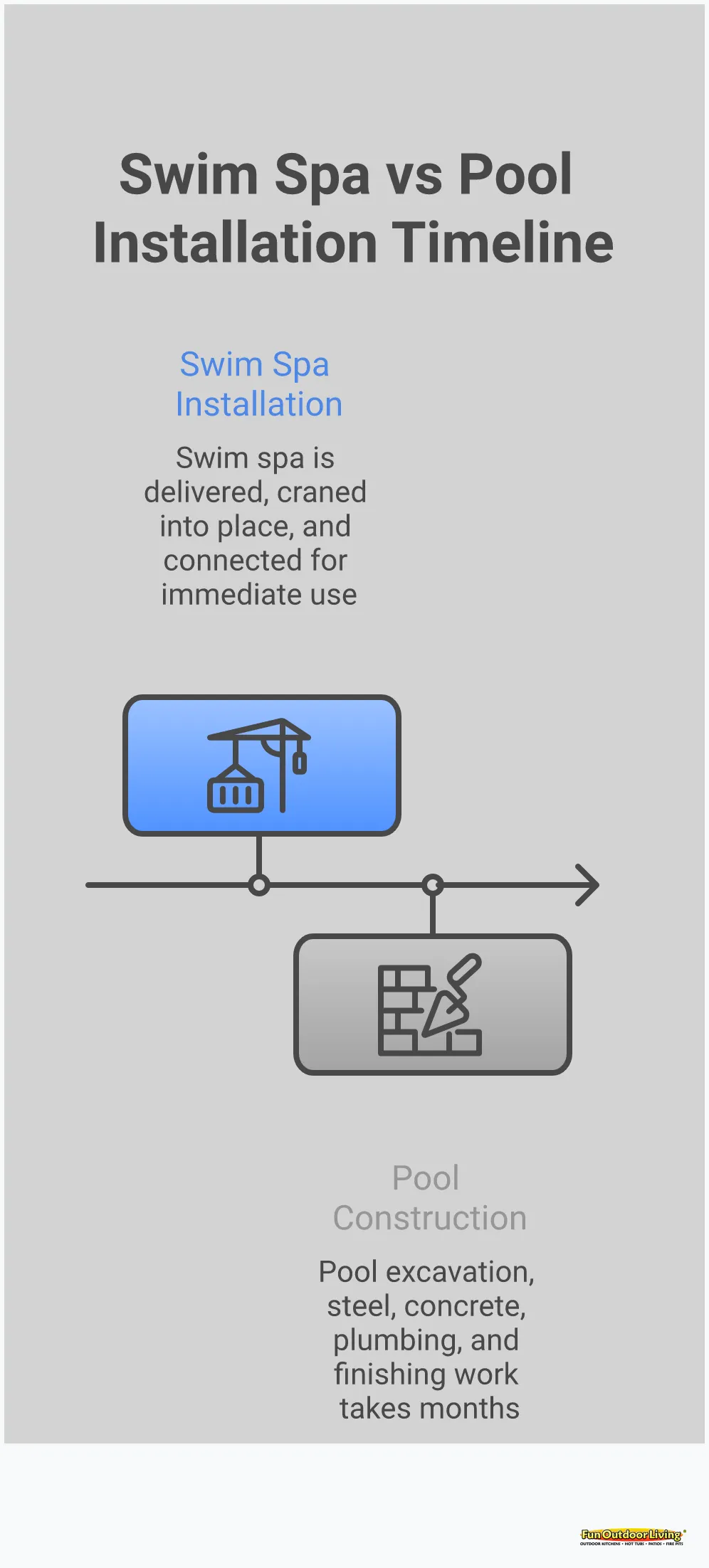
A swim spa installation is designed for minimal disruption. Because an Endless Pools® Fitness System arrives as a single, self-contained unit, the process is remarkably straightforward. It requires a solid, level surface—typically a reinforced concrete pad—and a dedicated electrical connection installed by a licensed electrician. Once the site is prepared, the spa is simply craned into place, connected, and filled. For most homeowners, this means the entire installation can be completed in a day, and you can be swimming that same evening. There’s no lengthy excavation or construction, allowing you to enjoy the benefits of your investment almost immediately.
The Steps to Building a Traditional Pool
Building an in-ground pool is a true construction project that unfolds over several weeks, or even months. The process begins with extensive excavation, followed by framing the pool’s shape, running complex plumbing lines, and installing steel rebar. From there, crews pour concrete or install a liner, finish the interior surfaces, and add coping and tile work. Each of these stages can be delayed by weather, material availability, or required inspections. The project completely takes over your backyard for its duration, involving heavy machinery and a rotating cast of specialized crews. It’s a significant undertaking that requires patience and a tolerance for a long-term work zone.
Planning for Site Work and Permits
Beyond the physical build, the planning and permitting process for a pool is far more involved. Here in the Carolinas, installing an in-ground pool always requires building permits, multiple inspections, and adherence to strict safety codes for fencing and barriers. This administrative work adds time and cost before any dirt is moved. A swim spa, on the other hand, is often treated like a portable hot tub by local authorities, meaning it may not require a permit at all. This simplifies the entire process, reducing upfront costs and eliminating potential bureaucratic delays. A free home consultation can help clarify exactly what your specific property and municipality will require.
What Are the Ongoing Costs of Ownership?
The initial investment is only part of the story. The true cost of owning a pool or a swim spa reveals itself over time through monthly utility bills and weekly maintenance routines. Understanding these recurring expenses is key to choosing an option that fits comfortably into your life and budget, without adding stress or unexpected work. For most homeowners, the long-term costs are driven by three main factors: water care, equipment maintenance, and energy use.
Water Care and Chemicals
The time you spend maintaining your water is time you can’t spend enjoying it. In our experience, this is where the difference between a swim spa and a pool becomes most clear. A swim spa’s smaller body of water is simply easier to manage. It requires fewer chemicals to keep balanced, and the routine is often less demanding. Many modern systems, like the Endless Pools® Fitness Systems we install, include advanced filtration that does much of the work for you.
A traditional pool, by contrast, has a much larger volume of water and is completely exposed to the elements. Rain, leaves, and pollen constantly alter its chemistry, requiring more frequent testing and larger quantities of chemicals to correct. For homeowners who want a simple, predictable routine, the contained environment of a swim spa is often a better fit. And if you ever have questions, you can bring a sample to any of our showrooms for a free water analysis.
Routine Equipment Maintenance
Both swim spas and pools need regular attention to keep their systems running smoothly, but the scale of the work is quite different. Maintaining a swim spa feels a lot like caring for a hot tub. The tasks include rinsing filters, wiping down the interior shell, and ensuring the cover is secure. All the components are self-contained in one unit, making inspections and service straightforward. For those who prefer a completely hands-off approach, our Spa Valet Plans can handle all the routine care for you.
A pool demands more physical labor. Weekly chores typically involve skimming the surface, vacuuming the floor, brushing the walls, and cleaning out skimmer baskets. The equipment is also more spread out, with separate pumps, filters, and heaters that all need monitoring. For homeowners here in the Carolinas, you also have to consider the seasonal work of opening and closing a pool—a significant task that isn’t a factor with a year-round swim spa.
How They Affect Your Utility Bills
Your monthly utility bills are where the efficiency of a swim spa really stands out. Because it holds significantly less water, a swim spa costs less to heat and keep warm. The most critical component is a high-quality, insulated cover, which comes standard with every swim spa. This cover traps heat and prevents evaporation, dramatically reducing the energy needed to maintain your desired temperature. This makes year-round use both practical and affordable.
Pools, on the other hand, are more expensive to operate. Their larger pumps run for longer hours, and the significant water volume requires much more energy to heat. Most pools are left uncovered, so any heat you add quickly escapes into the air. As a result, many pool owners find the cost of heating their pool prohibitive, limiting its use to the warmest summer months. A swim spa allows you to enjoy warm water any day of the year without worrying about a massive spike in your electricity bill.
How Much Space Do You Really Need?
The decision between a swim spa and a pool often comes down to the realities of your backyard. It’s not just about the dimensions on paper, but how you want your outdoor space to feel and function every day. A larger yard doesn’t automatically mean a pool is the right choice, just as a smaller space doesn’t rule out year-round aquatic wellness. Understanding the true footprint of each option is the first step toward making a confident decision for your home.
The Footprint of a Swim Spa
A swim spa offers the benefits of a pool and a hot tub in a single, self-contained unit. Because of this efficient design, it requires significantly less space. Most of the Endless Pools® Fitness Systems we install are between 12 and 19 feet long, making them a practical fit for smaller suburban yards, patios, or even enclosed spaces.
This compact footprint means you don’t have to sacrifice your entire backyard. A swim spa can be integrated alongside an existing deck, garden, or outdoor kitchen, preserving room for other activities. It’s designed to become a part of your outdoor environment, not dominate it, offering a dedicated zone for fitness, relaxation, and family fun without a massive construction project.
Planning for a Pool’s Dimensions
A traditional in-ground pool requires a much larger commitment of space. While an average recreational pool might be 10 by 20 feet, that measurement only accounts for the water itself. The true footprint includes the surrounding pool deck or patio, space for lounge chairs, and the area needed for the pump and filtration equipment.
In our experience, a pool becomes the central anchor of a backyard design. The entire landscape is often planned around it. This can be a beautiful and transformative choice for homeowners with enough room, but it involves a more extensive site plan. It’s a decision that shapes the flow and function of your whole outdoor living area for years to come.
Factoring in Landscaping and Safety Areas
Beyond the physical dimensions, both pools and swim spas require careful site planning. A level, stable foundation—typically a reinforced concrete pad—is essential for a swim spa. For a pool, extensive excavation and grading are the first steps. Both require clear access for maintenance and safe entry and exit points.
Homeowners in the Carolinas also need to consider local zoning and safety regulations, which often mandate specific types of fencing and secured access. These requirements add to the total space and budget needed for the project. This is where professional guidance becomes invaluable. We help you visualize the entire project, from placement and landscaping to permits, ensuring the final result is as safe and seamless as it is beautiful.
How Do They Fit into Your Daily Life?
Beyond the numbers, the most important question is how a pool or swim spa will feel as part of your daily routine. One is designed for expansive, seasonal fun, while the other offers focused wellness year-round. The right choice depends entirely on the lifestyle you want to create in your backyard. In our experience, homeowners are happiest when they choose the option that aligns with their everyday intentions, not just their summer plans.
For Fitness and Aquatic Exercise
If your main goal is a consistent fitness routine, a swim spa is built for that purpose. Models like Endless Pools® Fitness Systems create a smooth, adjustable current you can swim against endlessly without ever needing to turn. It’s a focused, low-impact workout that’s available anytime. Many systems also include options for resistance bands or rowing, turning a compact space into a complete aquatic gym. A traditional pool, on the other hand, is better suited for recreational swimming and casual laps. While you can certainly get a good workout, it’s a different kind of experience—more about freeform movement and play than structured training.
For Hosting and Family Fun
When it comes to entertaining, the best choice depends on the scale of your gatherings. A traditional pool is the undisputed champion of the big neighborhood party. Its large, open space is perfect for accommodating lots of kids, splashy games, and floating loungers. If you envision your home as the go-to spot for large summer get-togethers, a pool provides the room you need. A swim spa offers a more intimate setting. It’s ideal for family time, relaxing with a few friends, or teaching young children to swim in a warm, controlled environment. It blends the fun of a small pool with the social, conversational atmosphere of a hot tub.
For Year-Round Use and Wellness
Here in the Carolinas, one of the biggest differences we see is in the length of the season. A traditional pool is typically a summer-only feature, open for a few months before it needs to be closed for the cooler seasons. A swim spa, however, is designed for year-round enjoyment. Because of its smaller volume, superior insulation, and efficient heating systems, you can comfortably use it in the crisp autumn air or even on a mild winter day. This transforms it from a seasonal novelty into a daily wellness ritual. Whether for a morning workout or an evening soak, a swim spa provides reliable, on-demand hydrotherapy 365 days a year.
Common Misconceptions About Cost and Care
When homeowners in the Carolinas compare a swim spa to a traditional pool, questions about long-term costs and maintenance always come up. It’s easy to assume that a year-round body of water will be expensive and complicated, but the reality is often surprising. A swim spa is a self-contained system designed for efficiency, which changes the ownership experience entirely.
Let’s clear up a few common myths so you can feel more confident about what to expect.
The Myth of High Operating Costs
Many people assume that heating a body of water year-round will lead to high utility bills, but a swim spa is built differently than a pool. Because it holds significantly less water and comes with a custom-fit, insulated cover, it retains heat far more effectively. In our experience, the ongoing expenses for an Endless Pools® Fitness System are often lower than those for a traditional pool, which requires more energy to heat and more chemicals to treat a larger volume of water. This efficiency is what makes comfortable, year-round swimming and relaxation a practical reality.
Is Maintenance Really That Complicated?
The idea of daily water chemistry can feel intimidating, but swim spa care is more straightforward than you might think. The maintenance is very similar to that of a modern hot tub. It involves routine water testing, adding sanitizers as needed, and cleaning the filters. Because of its smaller size and advanced filtration, a swim spa manages debris much more effectively than a large, open pool. You won’t spend your weekends skimming leaves. And for homeowners who want a completely hands-off experience, our Spa Valet service can handle all the routine care for you.
Which One Is More Energy Efficient?
Energy efficiency is where a swim spa truly stands apart. A traditional pool is constantly exposed to the air, losing heat and requiring a powerful heater to maintain a comfortable temperature, especially during cooler months. A swim spa, on the other hand, is designed like a thermos. Its thick insulation and snug-fitting cover trap heat, so the system doesn’t have to work as hard. It heats up faster and maintains its temperature with minimal energy use, making it a far more sustainable choice for anyone who wants to enjoy the water beyond just the summer months.
What’s the True Cost of Ownership Over a Decade?
The initial price of a pool or swim spa is important, but it’s only the first chapter of the financial story. To make a truly confident decision for your home, it helps to look at the total cost of ownership over the long run—say, ten years. This timeframe gives you a realistic picture of what to expect for maintenance, energy use, and potential repairs.
In our experience helping Carolina homeowners, the most satisfied buyers are the ones who understand these ongoing costs from the start. It’s not about finding the cheapest option, but about choosing the one that delivers the most value and enjoyment with predictable, manageable expenses. A backyard investment should bring peace of mind, not financial surprises. Thinking about the decade ahead allows you to plan for a feature that fits comfortably into your life and budget, ensuring it remains a source of joy and wellness for years to come.
Planning for Repairs and Replacements
Over a decade, every backyard feature will require some upkeep. For a traditional pool, this often includes larger, more costly projects. Vinyl liners typically need replacing every 7-10 years, and plaster surfaces may need to be resurfaced—both significant expenses. In contrast, a swim spa is a self-contained vessel. While components like pumps, heaters, or the cover may eventually need replacement, these repairs are generally less disruptive and more affordable than resurfacing an entire pool. Because swim spas require less maintenance on a weekly basis, they tend to have lower ongoing expenses, making them a practical choice for busy homeowners. Our in-house technicians are always here to provide certified service for every component, ensuring your investment is protected.
The Long-Term Impact of Energy Use
Your utility bills are where the differences between a pool and a swim spa become most apparent over time. A swim spa’s greatest advantage is its insulated, lockable cover. This single feature dramatically reduces water evaporation and, more importantly, retains heat. Because they hold less water and are equipped with smaller, more efficient pumps, swim spas cost less to run. While electricity for the heater and jets is the main operating cost, it’s far more manageable than heating a large, open pool. This efficiency makes year-round swimming and hydrotherapy a realistic and affordable routine, not just a seasonal luxury. High-quality systems like Endless Pools are specifically designed for energy efficiency and consistent performance.
How They Affect Insurance and Property Taxes
The way your new water feature is classified can also affect your budget. In-ground pools are permanent home additions that almost always require fencing and extensive permits, which can lead to an increase in your homeowner’s insurance premiums and property taxes. Swim spas, however, are often treated like portable hot tubs. Because they come with integrated, locking safety covers, they may not require the same permitting or fencing, though it’s always important to check local regulations. This simpler classification can mean fewer administrative hurdles and a smaller impact on your annual home expenses. During a free home consultation, we can help you understand the typical requirements for your area so you can plan accordingly.
How to Decide Which Is Right for Your Home
Choosing between a swim spa and a traditional pool isn’t about which one is better. It’s about which one better serves your home, your family, and your daily routines. A traditional pool is often the centerpiece of summer gatherings—a place for play and social connection. A swim spa is more of a personal wellness tool, designed for year-round fitness, therapy, and relaxation.
In our experience helping homeowners across the Carolinas, the right decision becomes clear when you look at three key factors: your budget, your available space, and what you hope to gain from the water. By thinking through how you plan to use it day-to-day, you can find the solution that truly fits your life.
If Your Primary Concern Is Budget
For many homeowners, the financial investment is the starting point. A swim spa generally has a lower upfront cost than a traditional in-ground pool. The installation is also simpler and faster, which helps manage expenses. Beyond the initial purchase, swim spas are designed for superior energy efficiency, which means lower ongoing utility bills, especially since you can use them all year. This combination of a lower initial price and controlled long-term costs makes it a more approachable investment. We offer flexible financing options to help homeowners find a plan that fits comfortably within their budget.
If You Have a Smaller Backyard
Space is often the deciding factor for homeowners here in the Carolinas. A traditional pool requires significant square footage for the pool itself, plus the surrounding deck and safety fencing. For smaller or irregularly shaped yards, a pool simply may not be an option. A swim spa, however, offers a compact solution, typically ranging from 12 to 19 feet long. This allows you to get the benefits of a pool and a hot tub in one self-contained unit, leaving plenty of room for a patio, garden, or outdoor kitchen. You can see how seamlessly they fit into different spaces in our swim spa gallery.
If Wellness Is Your Main Goal
If your goal is to support your health, a swim spa is built for that purpose. While any swimming is good exercise, an Endless Pools® Fitness System is specifically designed for aquatic fitness, hydrotherapy, and daily wellness rituals. The adjustable current allows for stationary swimming, while powerful jets provide targeted massage for recovery. Because it can be used comfortably year-round, it becomes a consistent part of your routine for stress relief, low-impact exercise, and muscle recovery. A traditional pool is wonderful for seasonal recreation, but a swim spa is a dedicated wellness tool you can rely on every single day.
Related Articles
- Endless Pools vs. SwimEx: Best Aquatic Fitness Pools
- 4 Best Dual Zone Swim Spas: An Expert Review
- The Top Benefits of Exercising in a Swim Spa
Frequently Asked Questions
Can I really use a swim spa all year here in the Carolinas? Absolutely. A swim spa is designed from the ground up for year-round use, which is one of its biggest advantages over a traditional pool. Because it holds less water and includes a thick, insulated cover that traps heat, it’s incredibly efficient to keep warm. This means you can enjoy a morning swim in the crisp autumn air or a relaxing soak on a mild winter evening without a huge spike in your utility bill. It transforms the experience from a seasonal activity into a daily wellness routine.
Is a swim spa just a big hot tub you can swim in? That’s a common question, but they are two very different things. While a swim spa does offer the warm water and hydrotherapy jets you’d find in a hot tub, its main purpose is aquatic fitness. High-performance systems create a smooth, powerful current that’s strong enough for stationary swimming, resistance training, and even rowing. It’s a complete home gym and a relaxation tool in one, whereas a hot tub is purely for soaking and massage.
What’s the biggest “hidden cost” I should plan for? The most important thing to plan for is the site preparation. For a swim spa, this is fairly predictable and includes a reinforced concrete pad for a foundation and the cost of a licensed electrician to run the proper power supply. For a traditional in-ground pool, the additional costs are far more extensive and are a standard part of the project. You should plan for excavation, mandatory safety fencing, extensive decking or patio work, and landscaping, which can often equal or exceed the cost of the pool itself.
Which is better for kids and family fun? It depends on the kind of family fun you have in mind. If you envision hosting large neighborhood parties with lots of splashing and floating, a traditional pool’s wide-open space is hard to beat. However, a swim spa offers a more intimate setting that’s perfect for focused family time. The warmer water and controlled environment are ideal for teaching young children to swim, and the combination of a swim area and jet seats means there’s something for everyone to enjoy together.
How much weekly work is realistically involved in maintenance? The weekly upkeep is where you’ll notice a significant difference. Maintaining a swim spa is very similar to caring for a hot tub. It involves testing the water, adding chemicals as needed, and rinsing the filters, which usually takes less than 20 minutes a week. A traditional pool requires more physical labor, including skimming leaves from the surface, vacuuming the floor, brushing the walls, and cleaning skimmer baskets. It’s a much larger commitment of time and effort to keep it clean and balanced.