A home sauna is more than a wellness tool; it’s a space where you create a daily ritual for your health. The location you choose fundamentally shapes that ritual.
An indoor sauna offers unmatched convenience, making it effortless to step into a session before your morning shower or after a workout. It becomes a seamless part of your existing routine. An outdoor sauna, however, makes the journey part of the experience. The short walk across your patio creates a mental transition, helping you disconnect from the house and connect with your surroundings.
For homeowners deciding on an indoor vs outdoor sauna Charlotte, it’s a choice between integrated wellness and a dedicated escape.
Key Insight: “The best sauna isn’t the most expensive one; it’s the one you actually use. If walking outside in January feels like a chore, build it inside. If it feels like an invigorating escape, build it outside.” 🧖♀️❄️
Key Takeaways
- Choose Your Location Based on Your Routine: An indoor model offers seamless convenience for daily use, while an outdoor sauna creates an intentional, nature-connected wellness escape in your backyard.
- Match the Sauna to the Elements: Outdoor saunas must be built with premium, weather-resistant woods (like Canadian clear cedar) to survive the Carolinas. Indoor models offer more flexibility in materials and glass usage.
- Plan for the Total Investment: Indoor saunas often cost less to install because the foundation and climate control already exist. Outdoor saunas require hardscaping, structural foundations, and weatherproofing.
Indoor or Outdoor Sauna: Which is Right for Your Charlotte Home?
Choosing between an indoor and outdoor sauna isn’t about which one is better. It’s about how you want it to fit into your daily life.
Do you envision a private wellness retreat integrated into your master suite, or a backyard destination for relaxation and recovery? Both deliver the same profound health benefits, from stress reduction to improved circulation. The main differences come down to design, installation planning, and where you have the space to create your ideal ritual.
Comparing Design and Materials
The most significant difference lies in construction. An outdoor sauna is essentially a small, specialized outbuilding designed to withstand Carolina weather year-round. It requires highly durable, weather-resistant woods like cedar that can handle our humidity, sun, and temperature shifts without warping or degrading.
Indoor saunas, such as our premium Tylö sauna collection, are protected from the elements. This allows for a wider range of design choices, including expansive glass fronts, making it easier to match the sauna to your home’s interior aesthetic.
Planning for Installation in the Carolinas
Proper installation is the key to a safe and reliable sauna experience.
- Outdoor Requirements: Needs a perfectly solid, level foundation (concrete pad or reinforced deck) and a dedicated 240V electrical line trenched underground from your home’s panel.
- Indoor Requirements: Requires adequate room ventilation, appropriate flooring (tile or concrete), and a 240V electrical run through your interior walls.
Our design and build process handles all these logistics, so you can focus on the outcome, not the details.
Finding the Right Space in Your Home
The best location is the one that encourages you to use it most often.
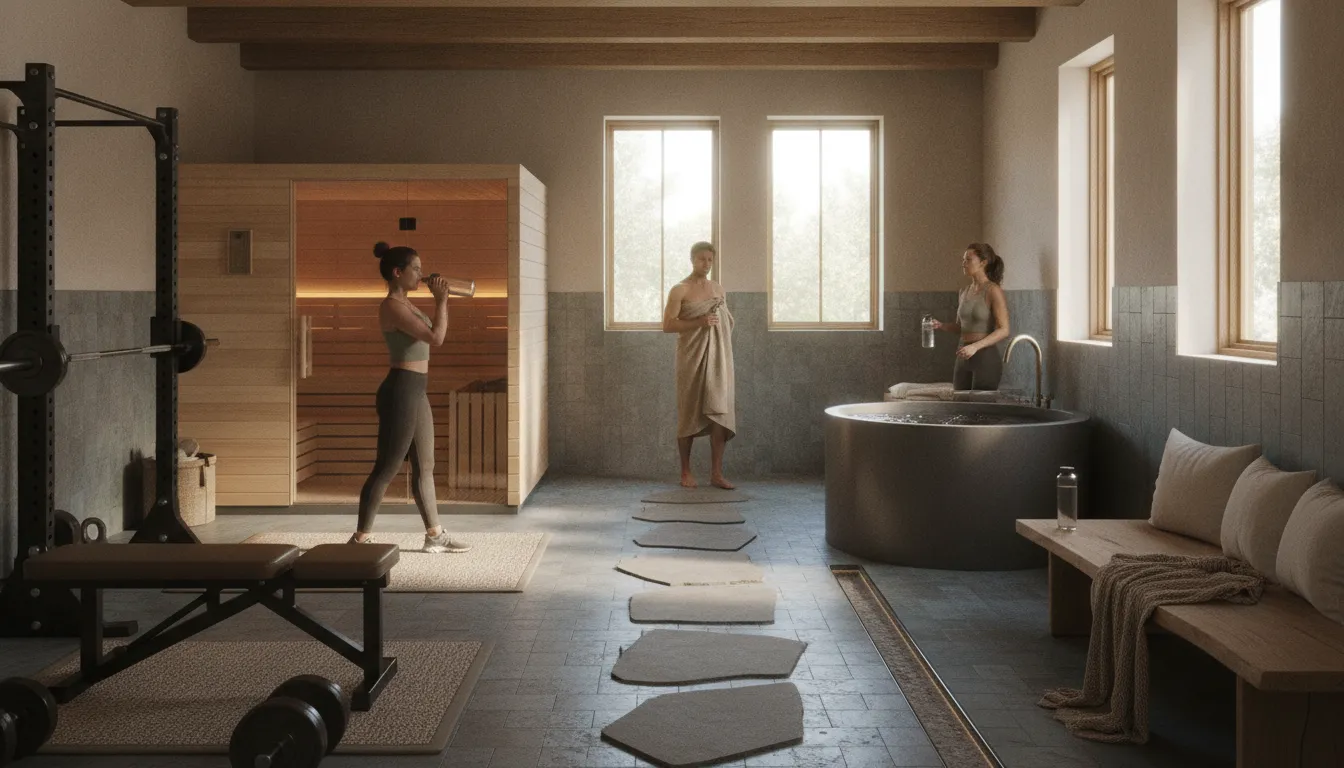
- Indoor Placements: Master bathrooms, finished basements, or home gyms.
- Outdoor Placements: Patios, pool decks, or as the anchor of a dedicated contrast therapy circuit paired with a cold plunge.
What Are the Real Costs of an Indoor vs. Outdoor Sauna?
Understanding the cost of a sauna goes beyond the initial price tag of the wooden cabin. It’s about looking at the complete investment, from site preparation to the energy it uses each week.
Upfront Purchase and Installation Costs
Generally, an outdoor sauna involves a higher upfront investment. While an indoor sauna installation typically ranges from $8,000 to $20,000+, a fully installed outdoor sauna project usually ranges from $15,000 to $35,000+.
Why the difference? An outdoor model must be built to withstand Carolina weather. More importantly, it requires heavy site preparation. You must budget for hardscaping (like pouring a concrete pad or laying outdoor pavers) and trenching the electrical lines through your yard.
What Drives the Cost Up (and Down)?
To give you complete control over your budget, it helps to understand the specific variables that affect your final price.
Factors That Drive the Cost Up:
- Outdoor Hardscaping: Building a new deck or retaining wall to create a level surface in a sloped backyard.
- Complex Electrical Runs: Trenching 240V wire 100 feet across a yard is significantly more expensive than running wire through an unfinished basement ceiling to an indoor unit.
- Custom Architecture: Designing a bespoke outdoor sauna to match your home’s roofline costs more than assembling a prefabricated kit.
- Electrical Panel Upgrades: If your home currently has 100-amp service, you will likely need an expensive panel upgrade to safely power a new sauna heater.
Factors That Keep the Cost Manageable:
- Indoor Placements: Utilizing an existing, level concrete floor in a basement or garage eliminates foundation costs.
- Proximity to Power: Placing the sauna right next to your home’s main electrical panel minimizes wiring labor.
- Prefabricated Kits: High-quality kits are engineered for rapid assembly, drastically reducing construction labor hours compared to a custom build.
Flexible Financing for Your Project
We believe that a wellness ritual should feel accessible. To make the investment more manageable, we offer straightforward financing options that allow you to fit your project into your budget. Spreading the cost over time makes it possible to get the sauna that truly fits your lifestyle without compromising on quality.
How Do Charlotte’s Seasons Affect Your Sauna Choice?
Here in the Carolinas, we experience all four seasons. This shifting climate is a key factor in deciding where to place your sauna.
LeisureCraft: Built for the Carolina Elements
If you choose to place your sauna outside, it must be built to survive the environment. This is why we rely heavily on LeisureCraft saunas for outdoor installations.
Handcrafted from premium Canadian clear cedar, their iconic barrel and Pure Cube designs are engineered specifically to handle intense UV rays and heavy rain. Unlike cheaper online kits made of thin hemlock that warp in our humidity, LeisureCraft models are a permanent landscape feature that will gracefully weather the Carolina seasons.
How the Seasons Impact Energy Efficiency
The location of your sauna directly affects its performance. An indoor sauna is already in a temperature-controlled 70-degree room. It doesn’t have to work hard to reach its target heat, meaning it heats up faster and uses less energy.
An outdoor sauna has to contend with the ambient air temperature. On a 35-degree winter day, it will naturally take longer and require more power to heat up. While premium outdoor saunas are incredibly well-insulated, it’s a practical trade-off to consider.
Which Sauna Type Fits Your Health Goals?
Choosing a sauna is about defining a ritual for your daily life. The right choice depends entirely on what you want to feel and how you plan to use it.
Traditional vs. Infrared Heat
- Traditional Saunas: Use a heater to warm stones (165°F – 195°F). You can pour water over the stones for bursts of steam. It’s an immersive, powerful heat that encourages a deep, cleansing sweat. It provides a cardiovascular workout similar to light exercise.
- Infrared Saunas: Use light panels to warm your body directly at a lower temperature (110°F – 130°F). It creates a gentler, radiant warmth that penetrates deep into muscles and joints, making it an incredible tool for post-workout recovery and reducing inflammation.
Common Sauna Myths We Hear in Charlotte
When homeowners visit our Design Centers, they often bring up concerns based on outdated information. Let’s clear up a few common myths.
Myth: “I Don’t Have the Space.”
Many people picture a massive, room-sized structure. In reality, today’s saunas are designed with flexibility in mind. A cozy two-person indoor model can fit comfortably in a 4×4 foot footprint. You don’t need a massive dedicated room to create a personal wellness retreat.
Myth: “An Outdoor Sauna Won’t Get Used in the Winter.”
We find the exact opposite is true. For many Carolina homeowners, winter is their favorite season for sauna use. Stepping out of a 180-degree room into crisp, 40-degree air is an invigorating sensory experience. It transforms a chilly evening into an opportunity for deep recovery.
How We Help You Plan Your Sauna Installation
Bringing a sauna home should feel exciting, not overwhelming. Our role is to handle the complexities of planning and installation so you can focus on relaxation.
Because we manage every step in-house, from the initial design to the final walkthrough, you have a single point of contact. There’s no need to coordinate with different contractors or hire your own electrician. We handle the site preparation, the 240V electrical trenching, and the county permitting.
When you’re ready, our team can help you visualize the possibilities during a free home consultation. We will measure your space, assess your electrical panel, and help you decide whether an indoor or outdoor retreat is the perfect fit for your lifestyle.
Related Articles
- Outdoor Sauna Charlotte: A Complete Buyer’s Guide
- The Ultimate Buyer’s Guide to an Outdoor Sauna
- Read Verified Reviews from Carolina Homeowners
Frequently Asked Questions
Can an indoor sauna cause moisture damage to my home? No, not if properly installed. Traditional saunas create “dry heat.” Even when you add water to the rocks to create steam (löyly), the overall humidity remains much lower than a standard hot shower. However, proper room ventilation is still required, which we assess during our site visit.
How much maintenance does a modern sauna really need? Very little. Premium cedar naturally resists moisture and bacteria. Routine upkeep involves laying down a towel when you sit and wiping down the benches occasionally. For outdoor models, we recommend applying a UV sealant to the exterior every 2-3 years.
Can an outdoor sauna be installed directly on my grass? No. It must be installed on a solid, perfectly level, and well-draining foundation (concrete pad, reinforced deck, or pavers). Placing it directly on dirt will lead to structural shifting and severe wood rot.
How long does the installation process take? Once the permitting is approved and the site is prepared, the actual assembly and electrical connection of the sauna typically takes just 1 to 2 days.
Which type of sauna is better if I’m just starting out? For those new to heat therapy, an infrared model can feel like a gentler introduction because it operates at a lower air temperature. However, the best way to decide is to visit one of our Design Centers to feel the difference for yourself.