A quick water check before a soak can catch a reading that needs attention before it becomes a bigger water-care puzzle. The challenge is choosing a test method you can use consistently and knowing which numbers matter for your sanitizer system.
Learn More about free hot tub water analysis
A hot tub water tester kit should measure your sanitizer, either chlorine or bromine, and pH; many spa kits also check total alkalinity and hardness. Choose readings and target ranges that match your spa and water-care system, then follow the kit and manufacturer instructions.
For owners in North and South Carolina, a home kit makes routine checks practical, while a second opinion can help when results are unclear or keep shifting. Start with the core readings, then consider which additional tests help you understand your water.
What Should a Hot Tub Water Tester Kit Measure?
When choosing a hot tub water tester kit, start with readings that tell you whether the sanitizer and water balance need attention: sanitizer level and pH. The exact panel can vary, but these two checks are the foundation of routine testing. The CDC identifies chlorine and pH as the first defenses against germs that can make swimmers sick, and advises residential hot tub owners to check both regularly.
First, confirm which sanitizer your spa uses. A chlorine-based system and a bromine-based system require different tests and guidance, so choose a kit that measures the sanitizer in your system. For chlorine, the CDC recommends a pH of 7.0 to 7.8 and at least 3 parts per million (ppm) chlorine in hot tubs. These are CDC recommendations, not a substitute for instructions for your particular spa and water-care system. Check the applicable product and equipment guidance before adjusting chemistry.
pH deserves its own check because it affects how well chlorine works and how comfortable the water feels. The CDC notes that chlorine’s ability to kill germs decreases as pH rises, especially above 8.0. At very low pH, chlorine’s germ-killing ability increases, but the water can also contribute to pipe corrosion. A test kit helps you spot a reading that needs attention rather than relying on appearance alone.
Many spa test panels also measure total alkalinity and hardness. Some manufacturer strips include both alongside sanitizer and pH readings. Treat these as supporting measurements: they provide more context when balancing water, but the appropriate target and response depend on the spa, sanitizer system, and manufacturer instructions. Do not assume every hot tub shares one universal set of targets.
- Sanitizer: The test should match your spa’s chlorine or bromine system.
- pH: Check this alongside sanitizer, since the readings work together.
- Total alkalinity and hardness: Helpful supporting readings when your system’s directions call for them.
For a clear starting point, look for a kit that covers your sanitizer and pH, then check whether its additional tests match your owner’s manual and water-care products. The CDC’s hot tub water testing guidance provides recommendations for chlorine and pH. A strip example listing alkalinity and hardness is available in the manufacturer’s test-strip instructions.
Which Hot Tub Water Tester Kit Type Fits Your Routine?
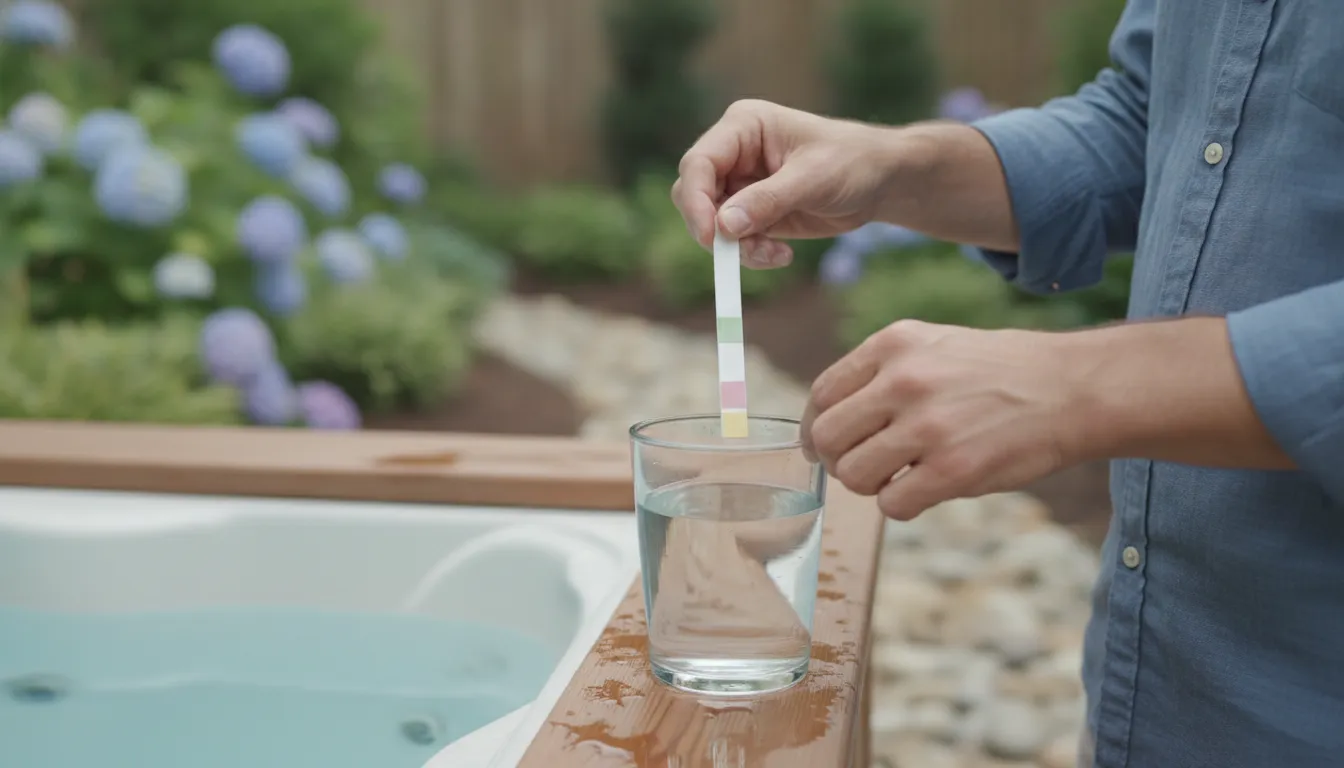
The right tester is the one you can use correctly and consistently, while still giving you enough detail to make a sound next decision. Think about whether you prefer a quick check, a more deliberate measurement, or help reading color changes. No matter which format you choose, follow its instructions and confirm that it tests the sanitizer and water-balance factors required by your spa system.
| Method | Convenience | Accuracy and reading clarity | Best fit |
|---|---|---|---|
| Test strips | Quick to use, with little setup. Check the package for expiration and keep strips stored as directed. | Results depend on comparing pad colors with the chart at the instructed time. The CDC says strips are less accurate than DPD kits for chlorine and pH testing. | Routine checks when speed and simplicity matter, and a small difference in color is not hard to distinguish. |
| DPD liquid or reagent kit | Requires measuring a sample and adding reagents carefully. It takes more steps than dipping a strip. | The CDC identifies a DPD kit as the most accurate method for testing chlorine and pH. Follow the kit’s directions closely for each test. | Owners who want a more precise check or need to investigate a reading that seems unclear. |
| Electronic reader | May read a compatible strip and display a result, reducing the need to match colors by eye. | Can make results easier to interpret, but capabilities vary by model. Verify which sanitizer and other parameters the specific reader measures; do not assume it tests a complete panel. | People who find color charts difficult to read and are comfortable checking device and strip compatibility. |
For the strongest accuracy guidance, the CDC recommends DPD kits for chlorine and pH and notes that strips are less accurate. That distinction does not make strips useless: a convenient test you perform as directed can be more practical for routine checks than a more involved kit you rarely use. If you choose strips, check the expiration date before buying or relying on an old container.
An electronic reader can help when color matching is the sticking point, but treat it as a device-specific tool, not a universal upgrade. Before purchasing, check the manual for the exact model’s supported strip type and test parameters, including whether it reads your sanitizer. If readings conflict with your spa manufacturer’s guidance or remain difficult to interpret, repeat the test according to its instructions or seek a second reading rather than guessing.
For any method, use the manufacturer directions as the authority on sample handling, timing, and interpretation. The CDC gives the same advice for all test types: follow the test manufacturer’s directions. Read the CDC’s guidance on hot tub water treatment and testing.
How Do You Get a Useful Test Result?
A careful test starts with the instructions for your exact kit, not a single routine that applies to every strip or liquid test. Sampling depth, dip time, mixing, and when to compare colors can all differ. CDC advises owners to follow the test manufacturer’s directions regardless of method. Read the CDC testing guidance alongside your kit insert.
- Check the kit before opening it. Confirm the test is intended for your sanitizer and spa, and check the expiration date on strips or reagents. Follow the package guidance for storage and handling. For example, Taylor’s pool-and-spa kit instructions say to store the kit in a cool, dark place and replace reagents annually. Those directions are specific to that kit, so use your own kit’s instructions instead of treating them as universal rules. See the Taylor instructions.
- Prepare a clean sampling tool and vial. If your method uses a vial, make sure it is clean and rinse it before testing if the manufacturer directs. Taylor’s kit, for instance, says to rinse tubes before and after each test. Use only the sample volume and collection method specified for your kit. Taylor gives an 18-inch sampling depth as its example, while one LaMotte strip package specifies a dip about six inches below the surface. These are different product instructions, not interchangeable standards.
- Collect the sample as directed. Follow any instructions about where to sample, whether to turn the jets off, and how long to dip or fill the tester. A LaMotte strip package says to turn off jets, dip six inches below the surface, and swirl three times. That is an example for that product only; do not turn off jets or use that depth unless your kit’s directions call for it. Keep the strip bottle dry inside: that LaMotte package warns against putting wet fingers in the bottle and says to close the cap tightly. Check the LaMotte strip directions.
- Observe the exact timing and lighting. Add the specified reagent in the correct order, mix only as directed, and start timing if the method requires it. Read or compare the result at the stated interval, not when convenient. For example, LaMotte says to read its strip immediately and recommends natural daylight for color matching. Another strip may require a different wait, so follow its own timing and chart.
- Record the result and investigate surprises. Write down the reading and the test method so you can compare like with like. If a chlorine test unexpectedly reads low or zero, CDC notes that chlorine above 10 ppm can bleach some tests and create a false-low result. Repeat carefully with the correct procedure or ask for a second reading rather than adjusting water based on an implausible result.
Keep the instructions with the kit. Small differences in depth, dip duration, and read time can change what the colors or reagent response tell you.
How Often Should You Test Hot Tub Water?
There is no single testing schedule that fits every residential spa. The right cadence depends on the sanitizer system, the spa maker’s instructions, the test kit directions, and how the water is being used. Use the routine specified for your model rather than assuming every hot tub should be tested on the same timetable.
CDC guidance calls for testing chlorine concentration and pH at least twice per day. And more often when a pool or hot tub is being used by a number of people. Its hot tub operations guidance says to test disinfectant residual and pH at least twice daily, or as often as hourly during heavy use. These recommendations address public or operational settings where water is shared and use can be frequent. They should not be presented as a universal residential schedule. Read the CDC’s water testing guidance.
At home, check the owner’s manual and the instructions for your sanitizer system and hot tub water tester kit. Some products provide their own cadence: for example, Leisure Time recommends testing twice weekly with its 4-in-1 spa strips. That is an example tied to that product, not a rule for every strip, sanitizer, or spa. Follow the directions that match the system you actually use.
Use and conditions can change sanitizer levels. Swimmer sweat and dirt, sunlight, and jets that create droplets or mist can reduce chlorine, according to the CDC. When the spa sees heavier-than-usual use, check the system guidance for whether you should test more often, rather than waiting for the next routine check. If your owner’s manual or sanitizer maker gives a specific response after heavy use, follow that advice.
Keep a simple record of readings and when you tested them. A pattern can help you notice whether readings shift after busy weekends or changes in use, and gives you useful information if you need help troubleshooting. For a broader routine that covers water care beyond testing, see this broader hot tub care schedule.
What If Your Test Reading Seems Wrong?
A result that does not match what you expected is a reason to check the test process, not to guess at a correction. A hot tub water tester kit can give an unreliable result if its strips or reagents are old. Damp, contaminated, or used outside the directions for that specific product.
Check the kit before you test again
Look at the expiration date, especially if the kit has been open for a while. The CDC advises checking the expiration date on test strips. Keep the container closed between tests, and do not touch strips with wet fingers. One strip maker gives those storage instructions, while liquid-kit guidance may call for storage in a cool, dark place and periodic reagent replacement. Follow your own kit label rather than assuming every product has the same storage life or replacement schedule.
Sources: CDC test-strip guidance; LaMotte strip instructions; Taylor kit instructions.
Repeat the test carefully
Color matching can be difficult, particularly under dim or strongly colored lighting. Use the lighting and comparison method specified by the manufacturer. Timing matters too: some strips must be read immediately, while other kits have their own wait times. Do not estimate a color after the stated reading window. If you use a liquid kit. Rinse the test tube as directed and keep the sample container clean so residue from a previous test does not affect the next result.
For a retest, collect a fresh sample and follow every step in the kit instructions. Including where to take the sample and how long to dip, mix, or wait. These details vary by product, so avoid substituting a familiar routine from a different kit.
A surprisingly low or zero chlorine result may also be misleading when chlorine is very high. The CDC warns that above 10 ppm, chlorine can bleach out some tests and produce a falsely low or zero reading. Do not treat that result as confirmation that the water needs more sanitizer; repeat the test according to the kit directions or seek a second reading. CDC guidance on testing chlorine and pH.
If repeated results remain inconsistent, or you have an ongoing equipment or water-care concern, ask for system-specific help rather than adjusting chemicals based on a questionable test. You can request hot tub service from Fun Outdoor Living.
When Is Free Water Analysis the Better Next Step?
A home test is useful for routine checks, but it only helps when the result is readable and gives you enough confidence to decide what to do next. If colors are hard to distinguish, repeat tests disagree, or you are unsure whether you followed the kit instructions correctly, pause before making another adjustment. A second reading can help you avoid reacting to a result that may not represent the water accurately.
Consider bringing a sample for review when:
- Your readings remain unclear or inconsistent. This can happen when a color match is ambiguous or a result changes unexpectedly between tests. Share what you measured and which kit you used so the team can understand what you are seeing.
- You are working with unfamiliar fill water or a different spa system. If you recently filled the hot tub, changed water-care products, or are learning a system with specific instructions, a second opinion may help you understand which guidance applies. Water-care systems vary, so do not assume another owner’s routine or targets fit your model.
- The water still seems out of balance after you followed the product label. Rather than adding more product based on guesswork, ask someone to review the reading and the steps you have already taken. Bring the product labels or note the products used, if available.
- You have a concern that may involve the equipment, not just the water. A test result cannot establish why a spa is operating differently. If you notice an operating concern, request service rather than treating the water as the only possible cause.
Fun Outdoor Living offers free hot tub water analysis at its showrooms in North and South Carolina. The team can review a water sample and help you understand a sensible next step for your spa; ask the showroom how to prepare or bring the sample. The goal is useful guidance, not a reason to keep adding chemicals without a clear plan.
If you also have a persistent equipment or operation concern, you can request hot tub service. Share the symptoms and any recent water-care changes when you contact the team. A home tester still has a role in regular ownership. But a professional review is a practical option when the result leaves you uncertain or the issue does not resolve as expected.
Learn More about free hot tub water analysis
Learn More about free hot tub water analysis
Frequently Asked Questions
What is the most accurate way to test hot tub water?
The CDC identifies a DPD test kit as the most accurate method for measuring chlorine and pH. Follow the kit’s directions closely; a result can be misleading if the sample or test procedure is off. CDC testing guidance.
What is the best hot tub water tester kit?
The best fit depends on your sanitizer system and how you prefer to read results. Choose a kit designed for your spa and sanitizer, with tests for the readings your owner’s manual calls for. Check the expiration date, and follow the manufacturer’s instructions rather than assuming one kit or target suits every tub.
Is a digital water tester better than test strips?
A digital reader can reduce the need to match strip colors by eye, but its capabilities depend on the specific model and compatible strips. Check which readings it measures and whether it supports your sanitizer system; do not assume a digital display alone guarantees accuracy.
How often should I test water in a home hot tub?
Follow your spa and sanitizer manufacturers’ instructions, and test more often during or after heavy use because bather waste, dirt, and jets can reduce chlorine levels. CDC guidance to test at least twice daily includes operator recommendations for pools and hot tubs. Do not treat that frequency as a universal residential schedule. One strip maker recommends twice-weekly testing for its product; check your own kit’s directions. CDC guidance.
Learn More About Free Hot Tub Water Analysis
If a test-strip color is hard to interpret or your readings keep changing, a second look can help you decide what to check next. Carolina hot tub owners can bring a water sample to a Fun Outdoor Living showroom for free water analysis. To get started, see details about free hot tub water analysis and choose the next step that works for you.