A hot tub problem rarely arrives at a convenient time.
A pump may not start, water may stay cloudy, or a leak may appear beneath the cabinet.
You may need an adjustment, a replacement part, or a trained technician.
Choosing carefully at the beginning can reduce downtime and prevent a small issue from becoming a larger one.
The best hot tub repair services explain what they found and show familiarity with your spa’s represented brand.
They separate water-care concerns from equipment faults and clarify the next step. Ask about diagnostics, parts, warranty paperwork, service-area coverage, and follow-up.
Local coverage matters for homeowners in Charlotte, Matthews, Lake Norman, Rock Hill, Winston-Salem, and nearby Carolina communities. The right provider should make the repair decision and the care afterward easier to understand.
Start by looking at qualifications, diagnostics, and capabilities. These details separate dependable service from a guess-and-replace approach.
What Should You Look for in Hot Tub Repair Services?
The right provider should do more than replace the first part that appears to be failing. Look for a team that can identify the underlying issue, explain options, and document what happens next.
That matters whether your spa is covered by a manufacturer warranty or has been in service for years.
Ask which brands and systems the technicians are trained to support. A provider should speak accurately about the represented brands it services. It should not imply that every make and model is covered.
Brand familiarity can make warranty paperwork, parts, and manufacturer-specific troubleshooting clearer. Confirm coverage before the appointment.
Look for a real diagnostic process
A good service visit should begin with symptoms and testing, not a guess. Ask how the technician evaluates the spa and which components may be involved.
Ask whether you will receive a written explanation of the recommended repair.
The process may include equipment, controls, plumbing, electrical systems, and water-care conditions. You should understand what was found and why the repair is recommended.
Confirm the provider’s service capabilities
Hot tubs combine pumps, heaters, controls, plumbing, covers, and water systems. A provider with broader capabilities may investigate connected problems instead of sending you between companies.
Useful capabilities can include:
- Diagnostic troubleshooting for equipment and operating problems.
- Pump, heater, and control-panel replacement.
- Plumbing leak investigation and repair.
- Electrical diagnostics and related safety checks.
- Cover repair or replacement, water-chemistry support, and seasonal startup or winterization.
| Area to compare | Question to ask | Why it matters |
|---|---|---|
| Brand coverage | Do you regularly support my brand and model? | Training and compatible parts can shape the diagnosis. |
| Diagnostics | What will you test before recommending work? | A clear process helps separate symptoms from the cause. |
| Parts | How are common and special-order parts handled? | You can plan for possible downtime without assuming a date. |
| Warranty | What documents and approvals may be needed? | Early clarity can reduce avoidable handoffs. |
Parts availability is another practical question. Ask whether the provider keeps common parts in inventory and how special-order components are handled.
Ask what happens if the original part is no longer available. Access to parts may reduce downtime, but no provider should promise a completion date before confirming the diagnosis and parts needed.
Understand warranty and follow-up expectations
Before work begins, ask who handles the warranty paperwork and what documents you need to provide. Also ask which portion of the repair may be outside warranty coverage.
Fun Outdoor Living’s service page includes warranty information sheets for Hot Spring products. They can help owners prepare coverage questions. Review the service and warranty resources.
Finally, expect clear next steps. A trustworthy provider should explain the work scope, needed parts, approvals, and follow-up.
Those details give you a useful basis for choosing service without relying on vague promises.
Which Questions Should You Ask Before Booking a Repair?
A short conversation before scheduling can show whether a provider is equipped for your spa. It can also show whether the visit will produce useful answers.
Share the brand, model, approximate age, and symptom. If you tried basic troubleshooting, note what you observed without assuming the cause. A hot tub troubleshooting guide can help you describe symptoms before you call.
- Which brands and models do your technicians regularly work on? Ask about training on represented brands, not just a general claim about hot tubs. Familiarity can affect how a technician narrows the possibilities.
- What will the diagnostic process include? Ask whether the technician will inspect components, test the system, and explain findings before recommending work. A clear process is more useful than a guess.
- How do you source replacement parts? Ask whether parts suit your model and whether alternatives are available if an exact part is unavailable. Do not authorize a replacement until you understand what it should solve.
- What warranty documents should I provide? Have purchase records, the serial number, service notes, and warranty information ready. Fun Outdoor Living provides Hot Spring warranty sheets on its service page.
- What is included in the proposed scope? Ask whether the recommendation covers diagnosis, labor, parts, testing, cleanup, or added work. Request the next steps in writing. This helps separate confirmed findings from possible follow-up work.
- How will we communicate during the repair? Confirm who will explain approvals, scope changes, and questions after inspection. Know how to reach the team and when to expect an update. Do not assume a fixed repair timeline.
- What follow-up is recommended after the repair? Ask what testing will happen before the technician leaves. Ask whether ongoing care could help prevent a repeat issue. If the concern is maintenance, review what a professional hot tub maintenance service includes.
Clear answers do not guarantee a simple repair. They make the decision more transparent.
Choose a provider that explains its process, limits, documentation, and next steps in terms you understand.
When Is a Hot Tub Problem a Safety Issue?
Some hot tub problems are inconvenient. Others mean everyone should stay out until the source is identified. Treat unusual electrical symptoms, exposed electrical equipment, and unsafe surroundings as safety concerns rather than routine maintenance questions.
Electrical warning signs deserve immediate attention
The U.S. Consumer Product Safety Commission identifies pumps, filters, vacuums, underwater lights, outlets, switches, and cords as possible electrical sources around pools and spas.
A loose cover or noisy pump may call for diagnosis. Do not repeatedly reset equipment with damaged wiring, water near electrical connections, or a recurring tripped breaker.
Wet skin and wet surfaces, including a wet deck or grass, can greatly increase electrocution risk when electricity is present. Keep people away from the spa and equipment.
Do not reach into the cabinet or handle cords while standing on a wet surface. A qualified technician can assess the power supply, grounding, controls, pump, heater, or another component.
What to do if someone feels a shock
Tingling, muscle cramps, difficulty moving, or a feeling of being held in place can indicate an electrical shock. The CPSC advises moving away from the source and getting out of the water.
Avoid grabbing a metal ladder if that could increase shock risk. If someone cannot exit safely, call emergency services. Follow professional instructions rather than entering the water yourself.
Until the cause is checked, stop using the hot tub and keep the area clear. The absence of a spark does not prove the equipment is safe.
When requesting hot tub repair services, describe what happened. Include tingling, breaker activity, burning odor, damaged cords, flickering lights, or water near electrical components. This helps the team triage without promising a diagnosis.
Read the CPSC electrical safety guidance for pools and spas for the complete safety information.
Is the Problem Water Chemistry or Equipment?
Not every hot tub complaint calls for the same service. Cloudy water, a strong chemical smell, or uncomfortable water may point to testing and sanitation.
A tub that will not heat, a dead pump, or a control panel that loses power points toward equipment diagnostics. Separating these issues can help you avoid replacing a component when the cause is water care.
The CDC recommends keeping hot tub water at or below 104 degrees Fahrenheit. It also recommends at least 3 parts per million of chlorine, or 4 to 8 ppm of bromine.
The CDC recommends a pH between 7.0 and 7.8. A strong chemical smell indicates a problem.
These measurements are useful starting points. They do not replace diagnosis when symptoms continue. Review the CDC’s hot tub water guidance.
- Start with water testing: Consider testing for cloudy or foamy water, odor, or trouble maintaining sanitizer and pH levels. Fun Outdoor Living offers a free hot tub water analysis.
- Request equipment diagnostics: Contact a qualified service provider when the spa is not heating, circulation is inconsistent. A pump is noisy or inactive, a leak persists, or controls and electrical components behave unexpectedly.
- Consider both: Water chemistry and equipment can affect one another. The CDC explains that pH outside the 7.0 to 7.8 range can either reduce chlorine effectiveness or make pipes more likely to corrode or break down. A technician may need to evaluate the water history alongside the mechanical symptoms.
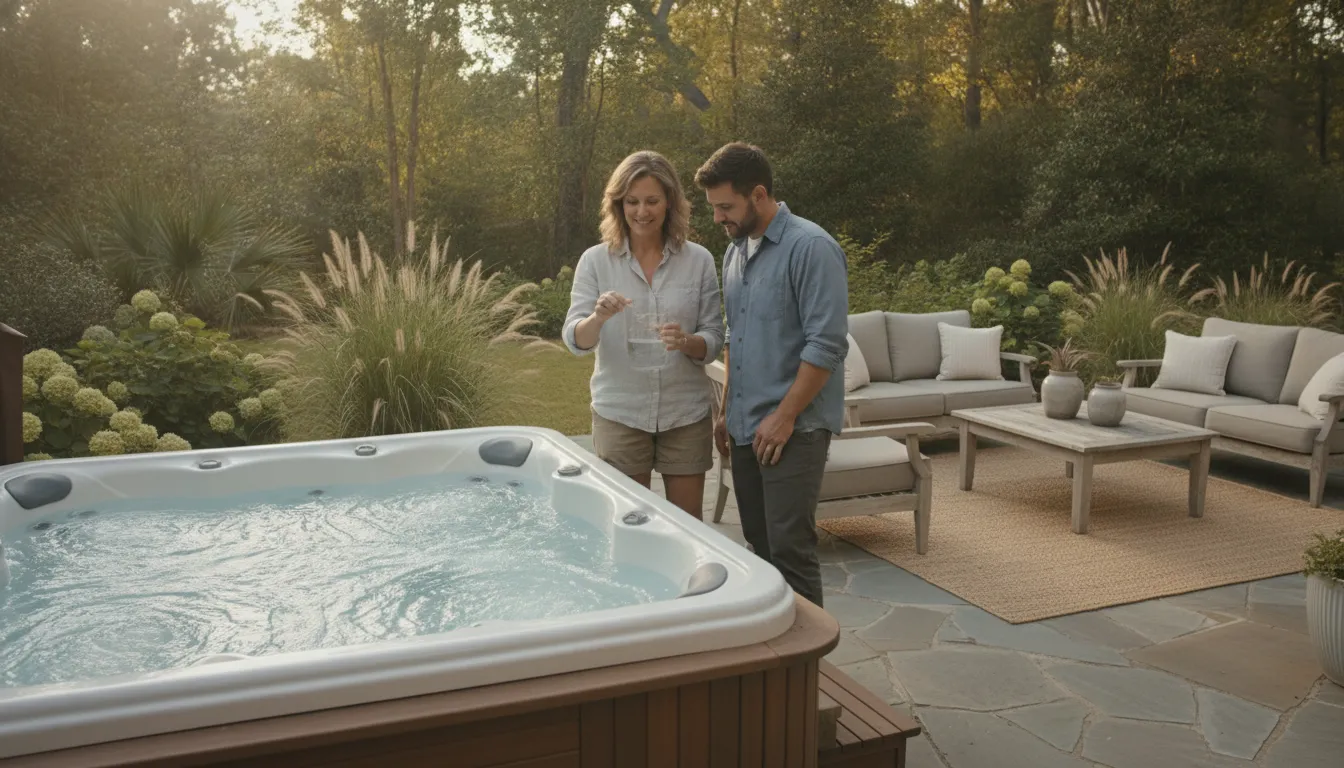
Routine care can also prevent a minor water issue from becoming frustrating. Fun Outdoor Living’s Charlotte hot tub care and service includes water care and inspections.
That differs from repairing a failed heater, pump, or control system. It may fit when the spa needs consistent upkeep rather than a one-time equipment fix.
When you contact hot tub repair services, describe the symptom, when it began, recent water readings, and anything that changed before the problem appeared. That information helps the provider decide whether to begin with water analysis, an equipment inspection, or both.
How Does Local Coverage Affect Hot Tub Repair Services?
Local coverage changes more than the distance a technician travels. It can affect who handles your request, how easily warranty information is shared, and whether you have a nearby place to discuss a recurring issue. For homeowners in Charlotte/Pineville, Matthews, Cornelius and Lake Norman, Rock Hill, or Winston-Salem, start by confirming that the provider actively serves your address today. Coverage can vary by neighborhood, technician availability, spa brand, and the type of repair.
Look for a clear service and warranty handoff
A local provider should be able to explain what happens after you submit a request. Ask whether the same service team handles diagnosis and follow-up, which brands its technicians are trained to support, and what documentation is needed for a warranty claim. Fun Outdoor Living’s service page provides hot tub warranty information sheets and accepts service or warranty requests. But homeowners should still confirm that their specific model and issue are covered before booking. That simple conversation can prevent a frustrating handoff between a retailer, manufacturer, and independent contractor.
Local accountability also means you have a practical way to continue the conversation if the first diagnosis raises questions. A provider with regional showrooms in Cornelius, Charlotte, Matthews, Winston-Salem, and Rock Hill gives homeowners more than a web form. Showroom access may make it easier to discuss equipment, review product documentation, or ask about a replacement decision in person. It does not replace an on-site assessment, and it should not be treated as a guarantee of faster service.
Confirm current availability before choosing
Before sending a request, provide your city, model information, symptoms, photos if appropriate, and whether the spa is under warranty. Then ask whether the provider currently serves your address, what the next communication step will be, and whether the issue is appropriate for its technicians. Avoid relying on an old service-area page or assuming that a nearby showroom means every surrounding ZIP code is included.
You can submit details through the Fun Outdoor Living service request page and verify current coverage directly. If you are comparing providers, also review recent customer reviews for evidence of clear communication and follow-through, not just broad star ratings. The best local fit is the provider that can clearly explain its coverage, brand expertise, warranty process, and next step for your particular spa.
A Simple Decision Path for Choosing a Repair Provider
When a hot tub stops working. A clear sequence can help you choose the right next step without guessing at the cause or committing to work you do not yet understand. Use this process to organize the information a provider will need and separate a safety concern from a routine service question.
-
Document the symptoms and identify the spa
Write down what changed, when it started, and whether the issue is constant or intermittent. Note error messages, unusual sounds, leaks, weak jets, heating changes, tripped breakers, or visible damage. Take a few photos if they clarify the problem. Record the hot tub’s brand, model, approximate age, and any recent work. This information gives a repair provider a more useful starting point than a general statement that the spa is not working.
-
Stop using equipment that may be unsafe
Do not continue soaking or resetting equipment simply to see whether the problem disappears when you notice burning smells. Damaged cords, exposed wiring, water near electrical components, repeated breaker trips, or signs of electrical shock. The U.S. Consumer Product Safety Commission identifies pumps, filters, underwater lights, outlets, switches, and cords as possible electrical sources around pools and spas. Wet skin and wet surfaces can increase electrocution risk. Keep people away from the equipment and seek qualified guidance rather than trying to diagnose energized components yourself. If someone experiences a shock in the water, follow the CPSC’s safety guidance to move away from the source and get out. Without touching a metal ladder if that could increase risk.
-
Separate water-care questions from equipment concerns
Cloudy water, odor, irritation, or persistent foam may point toward water-care needs, although they do not rule out an equipment problem. A temperature, circulation, leak, pump, heater, control, or electrical symptom may require a service diagnosis. Treat these as related but separate questions. Water testing can clarify chemistry, while a technician can assess mechanical and electrical components. Avoid assuming that adding chemicals will solve a heating or circulation fault.
-
Ask the provider focused questions
Before booking, ask whether the company works with your represented brand and model. How it approaches diagnosis, whether warranty documentation may apply, and what information it needs from you. Ask how the provider will communicate the findings, recommended work, parts needs, and any decisions that remain yours. Specific answers are more useful than a broad promise to service every make and model.
-
Confirm the scope and plan preventive support
Before work begins, make sure you understand the reported issue, proposed scope, and next step. If the provider identifies a water-care issue rather than a repair need, consider a free hot tub water analysis as a separate way to clarify maintenance. Once the immediate concern is addressed, ask what routine care could help you notice changes earlier. For a local request, you can submit the Fun Outdoor Living service request with the symptoms and spa details you documented.
Frequently Asked Questions
How do I know whether I need repair or routine maintenance?
Start with the symptom. A leak, unusual noise, heating failure, pump problem, or control issue usually calls for diagnostic service. Cloudy water, odor, or recurring balance problems may point to water care instead. A technician can evaluate both, while a maintenance plan can help reduce repeat issues.
What information should I have ready before contacting a service provider?
Note the hot tub brand and model if available, the symptoms, when they began, any error codes, recent water-care changes, and whether the unit recently lost power. Photos of the equipment area and a copy of your warranty paperwork can also help the provider determine the right next step.
When should I stop using my hot tub and request urgent help?
Stop using the spa if you notice tingling, a suspected electrical fault, exposed wiring, burning smells, or water near electrical components. The Consumer Product Safety Commission advises moving away from an electrical shock source and getting out of the water. Wet surfaces can increase electrocution risk. CPSC electrical-safety guidance provides additional precautions.
How quickly will a hot tub repair provider respond?
Response times depend on the provider, location, technician availability, and the nature of the problem. Fun Outdoor Living states that its service department will contact requests received during normal Monday-Friday working hours within 24 hours. That is a contact timeframe, not a promise that the repair will be completed within that period. Review the service request details before booking.
Ready to Submit a Hot Tub Service Request?
Choosing the right repair provider can make the next step clearer, especially when the cause of a problem is not obvious. Fun Outdoor Living can review the information you provide and help identify the appropriate service path based on your situation and current availability. To begin, submit a hot tub service request with the details you know. Clear symptoms, equipment information, and photos, when available, can help the team understand your request.