A patio can look beautifully finished on installation day and still develop movement, soft spots, or standing water if the layers beneath it were treated as an afterthought. In the Carolinas, changing rainfall, sloped yards, clay-heavy soils, and connections to existing walks or structures make preparation especially important.
A paver base is the compacted foundational layer beneath patio pavers. Built from appropriately graded crushed aggregate, it creates a stable, reasonably level platform while helping water move through the assembly instead of collecting beneath the surface. Proper preparation can make the patio more comfortable to walk across, reduce shifting under everyday foot traffic, and limit avoidable maintenance over time.
The right approach is not a universal depth copied from a general guide. It begins with understanding what the base does, then matching the materials, grading, compaction, and drainage plan to the site. That foundation-first view clarifies why this hidden layer matters as much as the pavers you see.
What Is a Paver Base, and Why Does It Matter?
A paver base is the foundational layer installed beneath pavers for patios, walkways, and other outdoor hardscapes. It is usually made from crushed stone with a blend of particle sizes, sometimes including stone dust. That material is not simply filler between the soil and the visible pavers. Once prepared and compacted, it creates the working surface that helps the finished installation perform as intended.
That foundation matters because pavers need more than a visually level starting point. They need support that can handle everyday use while responding to the conditions below and around them. The right base material and preparation can help create a solid, stable foundation and support drainage through the underlying layers. As this overview of paver base materials explains, the combination of crushed particles is selected to form a more compact surface than uniformly sized gravel may provide.
A more stable surface for everyday walking
When the base is properly prepared, it helps distribute the demands placed on the patio or walkway. Foot traffic, outdoor furniture, and normal changes in the site can put pressure on individual pavers. A compact foundation gives those units a more consistent surface beneath them, which can reduce the chance of movement over time. That does not make shifting impossible. Soil conditions, water, installation quality, edge restraint, and the way the space is used all influence how a paver surface behaves.
For a homeowner, the difference is practical. A stable walking surface feels more comfortable underfoot, and furniture is less likely to rock because of isolated low spots. The lines between pavers are also more likely to retain a clean appearance. These are small daily benefits that become more noticeable as a patio moves from a new project into a regularly used part of the backyard.
Leveling and drainage work together
A paver base also provides a uniform, level surface for placing the pavers. Level does not always mean perfectly flat. A qualified installation accounts for the intended slope so water can move away from structures rather than collect in the wrong place. The base supports that planned surface, while the surrounding grade and drainage strategy determine where runoff goes.
Crushed stone can promote drainage through the base and help limit water accumulation. That is useful, but it is not a complete drainage guarantee. Heavy rainfall, compacted or slow-draining soil, nearby foundations, downspouts, and existing slopes all deserve attention before installation begins. A base cannot correct every site condition by itself.
For an overview of material choices and site-specific installation considerations, explore outdoor paver installation. The most dependable design connects the base to the soil, grade, drainage path, and intended use of the space. It does not treat one standard recipe as suitable for every Carolina yard.
What Goes Under Pavers Besides the Pavers?
A finished patio may look simple, but the layers below it each have a different job. A properly selected paver base generally uses crushed aggregate with a range of stone sizes. The larger pieces provide structure, while smaller particles fill some of the open spaces so the material can compact into a stable foundation. Crushed stone’s irregular edges also interlock more effectively than smooth, uniform pieces.
That distinction matters when someone suggests using ordinary gravel or a bed of sand as a direct substitute. Materials that look similar in a landscape supply yard can behave differently under compaction, water, foot traffic, furniture, and seasonal soil movement. The right combination depends on the soil, drainage plan, slope, intended use, and site conditions. The Carolina paver patio guide offers broader planning context, while this section focuses on the foundation layers themselves.
| Material or layer | Primary function | Why it is not automatically interchangeable |
|---|---|---|
| Crushed or graded aggregate | Forms the firm foundation and supports compaction and drainage. | Its blend of particle sizes and angular edges is selected to create a tighter, more stable base than uniformly sized gravel. |
| Processed road base | Combines gravel-sized stone with finer stone dust to fill voids and compact. | A random gravel-and-dust mix may not have the same grading or performance. Product specifications and site use still matter. |
| Stone dust | Fills spaces between larger aggregate particles in some base materials. | Used by itself, it does not serve the same structural role as a designed aggregate base. |
| Bedding sand | Creates a thin, adjustable leveling layer above compacted base material. | Sand alone is not typically the primary base. It should not be used to disguise low areas or compensate for an inadequate foundation. |
| Joint sand | Is swept into the spaces between installed pavers to help lock them together and limit shifting. | It works between pavers, not as a replacement for the compacted foundation beneath them. |
Pea gravel is another example of why the label alone does not answer the installation question. Its rounded pieces generally do not compact like crushed stone or processed road base. A contractor may consider different materials for a particular site. But that choice should account for how the layer will lock together and manage water, not just whether the material is easy to obtain.
The sequence is important as well. The aggregate base is placed and compacted first. Bedding sand follows only after the base is stable and properly shaped, then the pavers are installed and joint sand is swept into the gaps. Keeping those functions separate helps the surface remain level and serviceable instead of asking one material to solve every foundation problem.
How Is a Patio Site Prepared Before the Base Goes In?
The preparation beneath a patio determines far more than how the surface looks on installation day. Iowa State University Extension identifies preparing the paver bed as the most important installation step, and notes that pavement performance is directly related to soil and base-material quality. The sequence should account for the planned use, nearby structures, existing grade, soil conditions, and where water needs to go. A base that is stable on one Carolina property may not be the right design for another.
- Plan the layout and finished elevations. Mark the patio boundaries, walkways, steps, planting areas, and any connection to an existing slab. Establish the finished height before digging, including the pavers and bedding layer. Near a house or other structure, plan the grade to move water away from the building rather than toward it. The amount of slope depends on the site and drainage plan, so an example found online should not be treated as a universal prescription.
- Excavate the site. Remove sod, roots, organic material, and unsuitable soil from the marked area. Excavation must allow room for the pavers, bedding material, and paver base, but there is no single correct base depth for every patio. Soil type, slope, climate exposure, intended loads, and drainage conditions all affect the design.
- Prepare and compact the soil. Shape the exposed subgrade to the planned elevations, then compact it after the area is leveled. This step creates a more consistent foundation and helps reveal soft spots before they are covered. If the underlying soil is weak or likely to mix with the aggregate, a site-specific design may include geotextile fabric between the soil and base.
- Place the paver base in workable layers. Use an appropriate graded aggregate rather than assuming ordinary gravel is interchangeable with paver base. Place the material in manageable lifts, following the design for the property, then compact each layer with the appropriate equipment. The aggregate should be built up evenly across the patio, not dumped into isolated low areas and left loose.
- Check the surface before bedding material. Confirm the base is compact, stable, and at the planned elevations. The base should be level or intentionally graded as designed before sand is added. Do not use extra sand to conceal an inadequate base or fill deep low spots. That common shortcut changes the installation sequence and can leave the pavers relying on an unstable foundation.
- Install edge restraint and review the work. Edge restraints are a distinct part of the installation sequence and help keep the completed field in its intended shape. Before pavers are laid, check lines, elevations, transitions, drainage direction, compacted areas, and the condition of the edges. These checks are easier and less disruptive before the bedding layer and pavers cover the work.
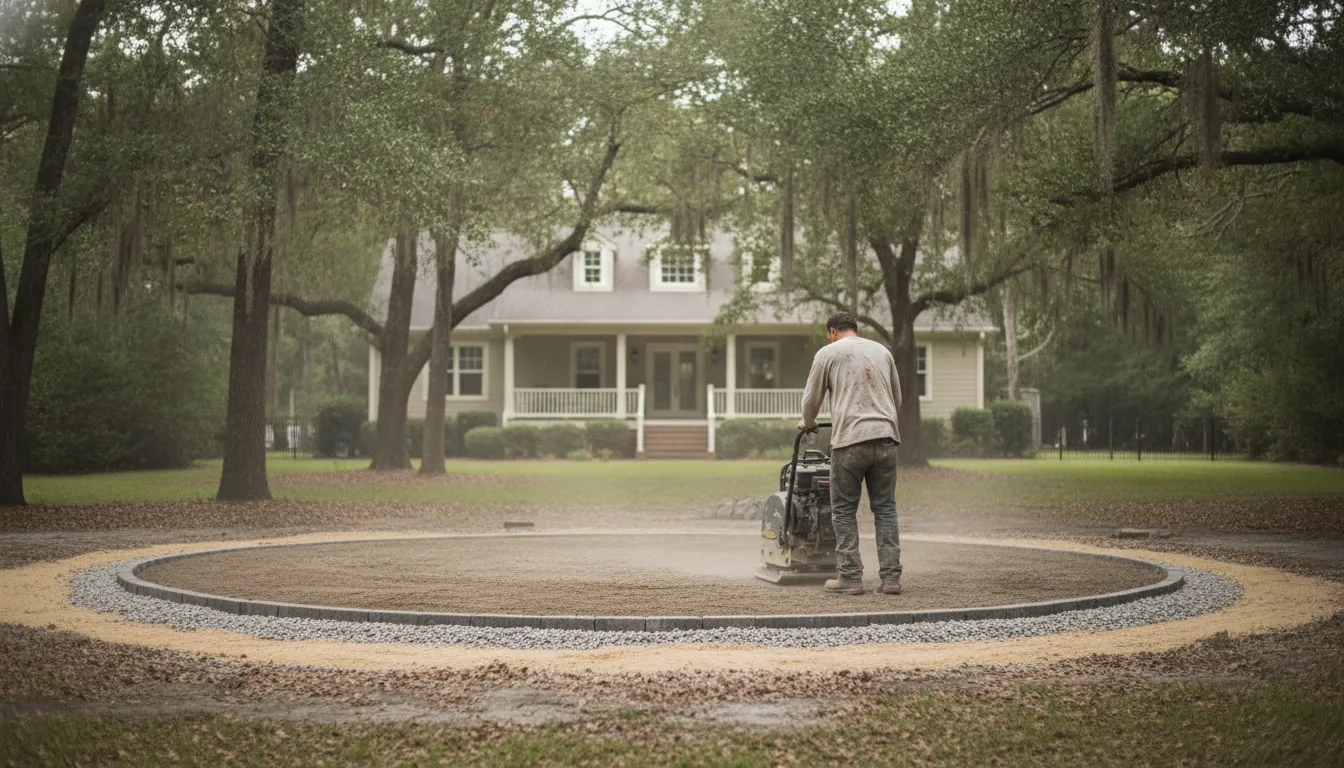
For a homeowner, the useful question is not simply how deep the base should be. It is whether the excavation, soil, aggregate, compaction, elevation, and edge details work together for that specific patio and its surroundings.
Preparation and installation sequence: Iowa State University Extension and Oregon State University Extension.
How Does a Paver Base Help With Drainage in the Carolinas?
A paver base is an important part of drainage, but it is not a complete drainage system. Its compacted aggregate layer creates a stable foundation beneath the pavers and can provide space for water to move through the base rather than collect directly beneath the surface. That benefit depends on the soil, grading, material selection, and installation quality. Pavement performance is closely related to the quality of both the soil and the base material, according to Iowa State University Extension.
Carolina sites can receive intense rain, and water may arrive from more than the patio itself. Roof runoff, an uphill yard, compacted soil, and neighboring hardscape can all send water toward the proposed installation. A well-built base cannot make that water disappear. The design must first identify where runoff starts, where it should go. And whether the surrounding soil can accept or direct it without damaging the home or creating a new problem.
Why grading matters near a house
When a patio meets a home, porch, retaining wall, or other structure, the finished surface should be planned to direct water away from that structure. Both Iowa State Extension and Oregon State University Extension emphasize downward drainage away from a house. The exact grade should not be copied from a general online rule. It depends on the existing elevations, door thresholds, foundation details, property lines, drainage easements, and the intended discharge point.
The same principle applies across the patio. A paved area needs a usable gradient so water can run toward an appropriate outlet instead of pooling or ponding. If the base is installed level while the surrounding site sends water inward, the aggregate layer is being asked to solve a grading problem it cannot solve. If the surface has low areas, adding extra bedding sand is not a reliable correction. The underlying preparation and elevations need to be addressed first.
Questions to ask before choosing the design
A site assessment helps connect the paver base to the larger drainage plan. Homeowners planning a patio in Charlotte, Matthews, Rock Hill, Lake Norman, Winston-Salem, or elsewhere in the Carolinas can ask:
- Where will water from the roof, yard, and nearby hardscape go during a heavy storm?
- How will the finished grade relate to doors, steps, foundation walls, and existing drains?
- Does the soil appear soft, compacted, slow to absorb water, or prone to holding water?
- Will the proposed runoff path affect a neighbor, retaining wall, planting bed, or property boundary?
- What base material and installation method fit this specific soil, slope, and use?
Qualified design choices begin with those conditions rather than a universal base depth or slope promise. Fun Outdoor Living’s consultation process includes on-site assessment, spatial planning, and 3D design visualization, which can help evaluate how a new patio fits the existing property. The goal is not to guarantee that every drainage issue disappears, but to coordinate the paver base, finished grade, runoff path, and site details before construction begins.
What Site Conditions Change the Design?
A paver installation should respond to the site, not to a copied base detail from an online checklist. Before work begins, ask what the soil is doing, where water moves, what surrounds the patio, and how the finished surface will be used. Those answers can affect excavation, material selection, edge treatment, and the way the base is separated from the ground below.
What is beneath the surface?
Soft, disturbed, or expansive soil may not behave like firm, well-drained ground. Ask the professional how the existing soil will be evaluated and whether it should be removed, improved, or separated from the base. A geotextile fabric can be placed beneath the main base material as a site-specific tool. It may help keep the base from mixing with the underlying soil, but it is not a universal substitute for proper excavation, grading, or compaction. The right choice depends on the conditions found on the property.
How will slope and surrounding structures affect the layout?
A sloped yard can change both the shape of the patio and the way its edges are supported. A new surface may also meet a porch, retaining wall, driveway, steps, or home foundation. Ask where the finished grade will sit at each tie-in, how transitions will be handled, and whether water has a clear path away from structures. A design that looks simple from above may require careful elevations and edge details to avoid awkward steps, trapped runoff, or a surface that feels disconnected from the rest of the yard.
What could roots, loads, and access change?
Existing trees deserve special attention. In some landscape applications, pavers can be installed over a sand sub-base without cutting roots. However, expanding roots can eventually lift pavers, creating a maintenance issue that may require resetting them as the root grows. Ask whether the proposed layout protects important trees, allows for future maintenance, and accounts for likely root movement. Do not assume that removing a visible root is the best solution.
Also discuss intended loads and construction access. A walkway used mainly for foot traffic presents different planning questions than a patio supporting substantial furniture, an outdoor kitchen, or frequent service access. Ask how materials and equipment will reach the work area, whether narrow gates or existing landscaping create constraints, and how the design will protect nearby structures during installation.
For a Carolina homeowner, a useful professional conversation should cover soil, slope, roots, tie-ins, use, access, and long-term maintenance together. Fun Outdoor Living provides local site assessment, spatial planning, and 3D design through its consultation process. Its work includes North Carolina patios and walkways, with service across markets such as Charlotte, Matthews, Cornelius, Rock Hill, and Winston-Salem.
Frequently Asked Questions
What is the best base for pavers?
The best base is a properly graded, compacted aggregate blend designed for the site and intended use. Crushed stone or processed road base typically combines different particle sizes, allowing the material to interlock and compact into a stable foundation. The right selection can change with soil, slope, drainage, expected loads, and nearby structures, so there is no single material or depth that fits every Carolina patio.
Do I need paver base or just sand?
Most patios need a compacted paver base beneath the bedding sand. Sand helps create a smooth, adjustable layer for placing the pavers, but sand alone is not typically used as the primary foundation. Separating these roles helps the installation manage stability, leveling, and drainage rather than asking one thin layer to do every job.
What base should I put under pavers?
Use a site-appropriate compacted aggregate base, followed by the specified bedding layer and joint material for the paver system. Ordinary gravel is not automatically interchangeable with paver base because particle size and shape affect compaction and interlock. Soil conditions may also call for additional preparation, such as geotextile fabric to help keep base material from mixing with the soil below.
Can I lay pavers directly on gravel?
Not usually, unless the gravel is part of a properly prepared and compacted base system. Loose or uniformly sized gravel may not compact tightly enough to support a consistent surface. A durable installation requires prepared soil, controlled grading, compacted base material, a suitable bedding layer, edge restraint, and correctly installed joint material. A site assessment is especially important where drainage, roots, slopes, or heavy use are involved.
Schedule a Better Foundation for Your Patio
A well-prepared paver base helps your patio feel stable, comfortable, and easier to maintain over time. Because soil, slope, drainage, and intended use vary across Carolina properties, a site-specific plan is more useful than copying a standard installation detail. Fun Outdoor Living can help you think through the foundation and drainage approach before construction begins.