A swim spa can support more than one kind of workout, from steady water walking to swimming against a current. That variety is useful, but it also means there is no honest, universal calorie number for every session.
When burning calories in a swim spa, energy use depends on the activity, effort, time, and pace. Body size, fitness, water temperature, and equipment settings matter too. The 2024 Adult Compendium of Physical Activities uses MET values to compare activity intensity. A MET is a rate of energy use, not a personal calorie total. Use it as context rather than a guaranteed result.
For a practical estimate of effort, use the CDC talk test. During moderate activity, you can talk but not sing. During vigorous activity, you can say only a few words before you pause for breath. The useful question is how your movement, resistance, and current change the work.
Schedule a free home consultation
What Changes Burning Calories in a Swim Spa?
Energy use in a swim spa is not a single number. Your body responds to the conditions of the session, how hard you work, and what you do in the water. Four variables make the biggest difference.
- Water resistance.
- Workout intensity.
- Duration.
- Exercise selection.
Water creates resistance in every direction, so moving your arms and legs can require more effort than the same motion in open air. The amount of resistance you feel still depends on the movement, your pace, and whether you are walking, swimming, treading water, or using equipment. A current or other training setup can also change how continuously you need to work.
Intensity means how hard you are working, not simply how long you stay in the water. The CDC classifies activity at 3.0 to 5.9 METs as moderate and activity at 6.0 METs or more as vigorous. As a practical check, moderate exercise usually lets you talk but not sing. During vigorous exercise, you can generally say only a few words before pausing for a breath. The same activity may feel harder for someone who is less fit.
Duration matters because a longer session gives you more time at your chosen effort. A shorter session may be more demanding if you raise the intensity. Exercise selection matters too. The 2024 Compendium of Physical Activities lists different MET values for water walking, water aerobics, swimming, and treading water, reflecting differences in effort and movement.
A MET is a rate of energy use, not your personal calorie total. It should not be converted into a promised number without considering factors such as body size, fitness, water temperature, stroke, and exact pace. For a broader look at the benefits of swim-spa exercise, notice how a session feels. Consistency matters more than a fixed calorie claim.
How Does Water Resistance Change the Work?
Water changes the feel of a familiar movement. Reaching, walking, pressing, or swimming against the water asks your muscles to work through resistance. That push is not present in the same way when you move through air. That added demand can support a more active session without requiring impact-heavy exercise on land.
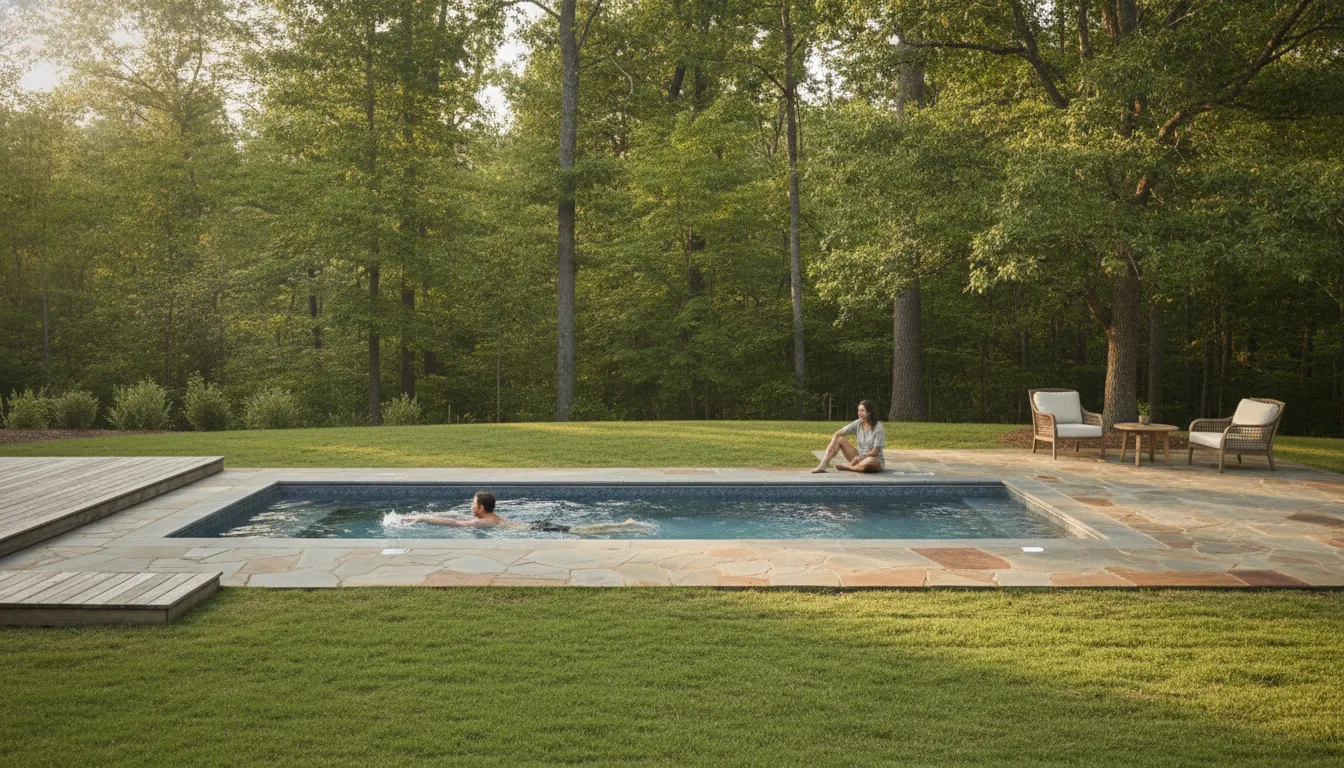
Buoyancy can make movement feel easier on the joints because the water supports part of your body weight. At the same time, the water still pushes back as you move. Those two effects can work together: an exercise may feel more comfortable than its land-based version while still asking you to produce effort. That is one reason low-impact aquatic fitness can fit into a routine for people who want a gentler way to stay active. It is not a promise of joint healing, and your experience will depend on the movement, pace, duration, and your own fitness level.
An adjustable current gives you another way to control the challenge. Increase the current and the same swimming motion meets more resistance. Lower it when you want to focus on technique, warm up, or keep the effort more manageable. You can change the demand without changing the basic exercise, which makes it easier to adjust a session as your energy or goals change. This matters when thinking about burning calories in a swim spa. There is no single result for every person. A calorie estimate should not be treated as a guarantee.
Endless Pools Fitness Systems are designed around this kind of adaptable movement. Fun Outdoor Living offers Endless Pools Fitness Systems in the Carolinas, with smooth adjustable swim currents, optional underwater treadmills, and fitness accessories. Depending on the model, lengths include 12, 14, 15, 16, and 18 feet. That range can provide room to choose a setup that suits the space and the way you expect to use it. You might swim against a current, walk on an underwater treadmill, or add resistance accessories.
For a closer look at how an at-home system can support water-based movement, explore this home aquatic exercise pool. The goal is not to chase a fixed number. It is to find a level of resistance that feels purposeful, adjustable, and sustainable for the way you want to move.
How Do Duration and Exercise Choice Compare?
When you are burning calories in a swim spa, both the activity and the time spent doing it matter. The published MET values below provide a consistent way to compare effort across water walking, aerobics, and swimming. They are activity rates, not a promise for a specific person or swim spa.
These values come from the Adult Compendium water activities list. The descriptions of pace and effort are useful for comparison. Your experience can still vary with fitness, stroke, water temperature, body size, and exact pace.
| Activity example. | Published MET. | What that pace feels like. |
|---|---|---|
| Water walking, light. | 2.5. | Easy, slow movement. |
| Water walking, moderate. | 4.8. | Steady, moderate movement. |
| Water walking, vigorous. | 6.8. | Brisk, demanding movement. |
| Water aerobics, general. | 5.5. | Active class-style effort. |
| Water aerobics, high intensity. | 7.5. | Hard, high-effort movement. |
| Leisurely swimming. | 6.0. | Comfortable, non-lap swimming. |
| Slow recreational freestyle. | 5.8. | Relaxed freestyle laps. |
| Medium crawl, about 50 yards per minute. | 8.0. | Vigorous, sustained swimming. |
| Fast freestyle laps. | 9.8. | Very vigorous lap swimming. |
A longer session at the same effort uses more total energy, but only if you can keep that pace comfortably. That makes a sustainable activity a practical choice. A slower pace you can maintain may be more useful than a faster pace that forces you to stop. For ideas on getting started, see our beginner swim spa exercises; that page covers how to start, not calorie math.
Why Can Endless Pools Support a Low-Impact Routine?
An Endless Pools Fitness System can make it easier to tailor an aquatic workout to how you feel that day. Its adjustable, smooth current lets you choose an effort that feels manageable instead of matching a fixed pace. That flexibility can be useful when your goal is consistency rather than pushing through every session at the same intensity.
Water buoyancy supports part of your body weight. The same movement may feel kinder on your knees and hips than a similar activity on land. That does not make an Endless Pools system a medical treatment, and comfort can vary from person to person. It does give homeowners another setting to consider when comparing ways to stay active at home.
Depending on the model, optional equipment may expand how you use the system. Some models can be configured with an underwater treadmill or resistance accessories, while others may be better suited to swimming and basic water exercise. Ask which features are available on the specific system you are considering rather than assuming every model includes the same equipment. You can also compare swim spa treadmill options before visiting a showroom.
The swim space is compact compared with a traditional lap pool. Endless Pools Fitness Systems are available in lengths from 12 to 18 feet. That compact size may be worth considering when a full-size pool is not practical. The right size still depends on your available space, access route, installation requirements, and the activities you want to do.
For a low-impact routine, begin with a plan you can repeat:
- Pick a comfortable effort. Start with a current setting that allows controlled movement and relaxed breathing. You can increase the challenge later if it feels appropriate.
- Choose one activity. Focus on swimming, walking, or another available feature rather than trying to use every accessory in one session.
- Set a duration you can repeat. A consistent, manageable session is a more practical starting point than an ambitious schedule you cannot maintain.
- Adjust the current instead of forcing pace. If the effort feels too easy or too demanding, change the current to suit the day rather than straining to keep up.
Fun Outdoor Living helps Carolina homeowners compare these systems in showrooms in Charlotte/Pineville, Matthews, Cornelius, Rock Hill, and Winston-Salem. Browse the swim spa gallery to see the available options, then discuss dimensions and features with the team.
How Can You Judge Effort Without a Calorie Count?
When you are thinking about burning calories in a swim spa, effort and time tell you more than a device. A device calorie estimate is uncertain. Your body size, fitness level, water temperature, stroke, and pace can all change the result, so use how the session feels as a practical guide.
The how the CDC measures intensity guidance offers a simple talk test. At a moderate effort, you can talk but would not want to sing. At a vigorous effort, you can say only a few words before pausing for a breath. You can pair that test with a 0-to-10 effort scale: around 5 or 6 feels moderate, while 7 or 8 or higher feels vigorous. The same pace may feel harder for someone who is less accustomed to exercise, so your own perceived effort matters.
For a beginner, imagine three different sessions. First, you walk easily through the water and speak in full sentences without changing your breathing. That is a light effort, and it may be a comfortable way to become familiar with the space. Next, you increase to a moderate walking pace. You can still talk with a partner, but singing would be difficult. Finally, you add a short harder interval. You can get out a phrase, then need a breath before continuing. That is a clear sign the effort has moved higher, even if the interval does not last long.
These examples are ways to notice intensity, not a workout plan or a promise of a specific calorie total. A longer, easy session can use as much total energy as a short, hard one because duration matters alongside intensity. Conversely, a brief vigorous effort can feel demanding without matching the total work of a much longer session. Look at both pieces when you reflect on a swim spa session.
Keep safety ahead of any number. Stop if you feel chest pain or dizziness. Ask a clinician if you have a medical condition or questions about whether this activity is appropriate for you. This information is educational, not medical advice. For practical context from people who own these systems, browse the owner reviews. Then judge any session by your own comfort, not by a fixed claim.
Compare swim spas for a low-impact routine
Frequently Asked Questions
How many calories can you burn in a swim spa?
There is no dependable calorie count for every swim-spa workout. Energy use changes with your body size, fitness, water temperature, current resistance, stroke, pace, and workout length. Treat calorie estimates as rough guidance, not a guaranteed result.
Is 30 minutes of swimming a day enough to lose weight?
Thirty minutes can be a useful part of a weight-management plan, but it does not guarantee weight loss on its own. Your overall activity, food intake, workout intensity, consistency, and individual health all matter. Build duration and resistance gradually, and choose a routine you can repeat comfortably.
What burns more energy, walking or swimming?
It depends on how hard you work. The 2024 Adult Compendium of Physical Activities lists water walking from 2.5 to 6.8 METs. Swimming activities in that list run from 5.8 to 9.8 METs. Pace and effort change the comparison. The CDC talk test can help. During moderate activity, you can talk but not sing. During vigorous activity, you can say only a few words before pausing for breath. Sources: 2024 Adult Compendium; CDC.
Can a swim spa support low-impact exercise?
Yes. Water-based movement can be a lower-impact option than many land exercises. A swim spa can support swimming, water walking, and water exercise. Endless Pools Fitness Systems can provide adjustable swim currents, with optional underwater treadmills and fitness accessories. Start at a comfortable effort and adjust the session to your abilities.
Plan the Session Around What You Can Repeat.
Burning calories in a swim spa is easier to manage when you treat it as a set of choices. It is not a score. Resistance, effort, time, and the movement you pick all change the work. A published MET value can show why a brisk water walk differs from easy paddling, and why fast freestyle sits higher still. It cannot tell you what your body used on a given afternoon.
Endless Pools Fitness Systems can support that kind of low-impact routine because the current is adjustable and the water carries part of your weight. Fun Outdoor Living can walk through sizes, current settings, and optional equipment with you. That can happen in a Carolina showroom or in the yard where the system would go. Bring the pace you can keep, not a target calorie number.
If you want help matching a system to the way you like to move, request a free home consultation. You can also read how other owners describe their setups in customer reviews. Then decide what a comfortable week of sessions would look like for you.