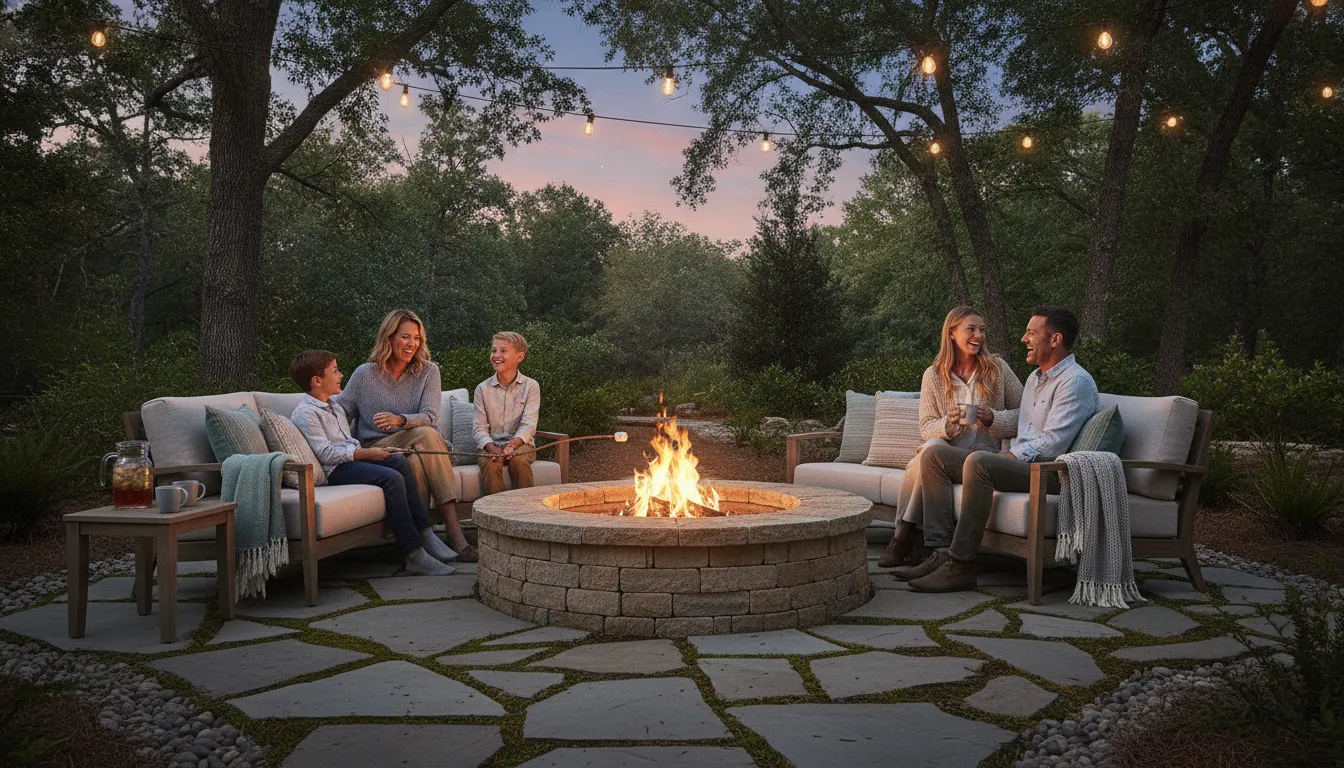
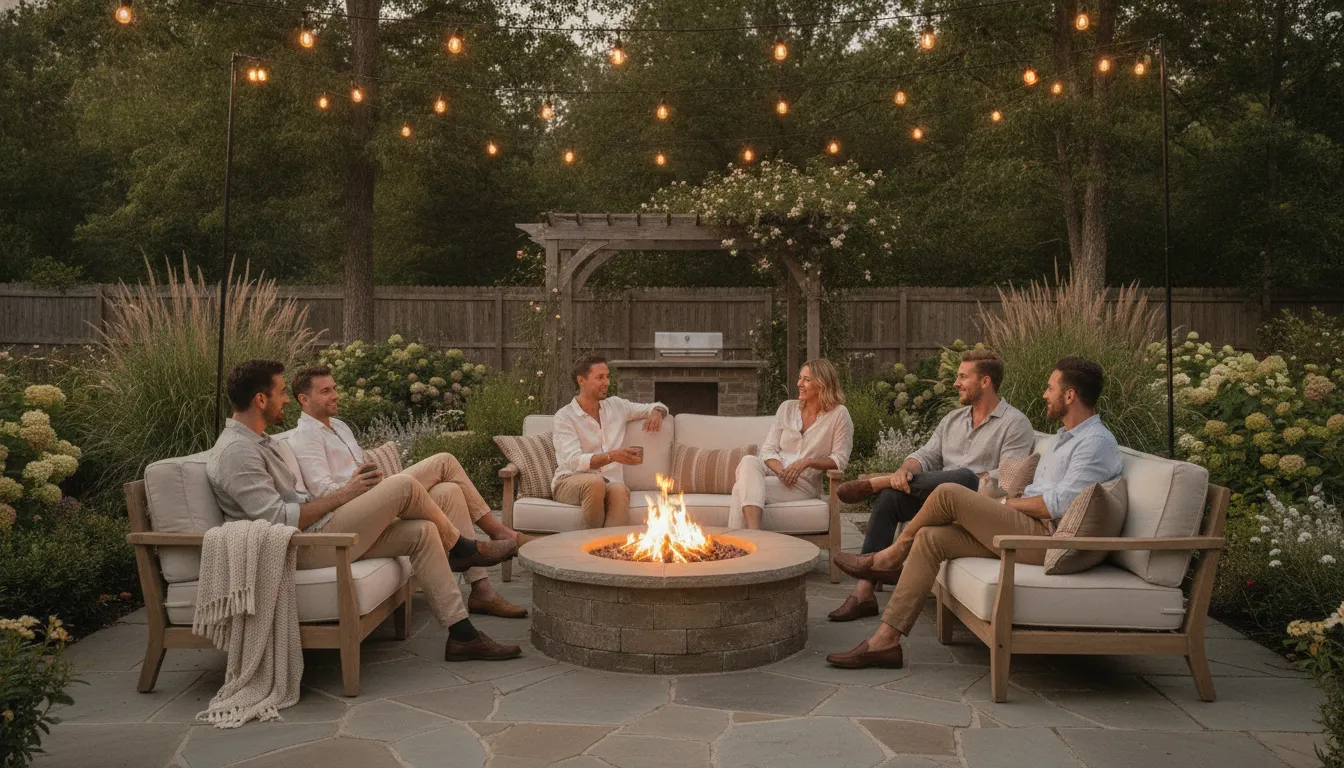
A well-planned fire pit can turn an ordinary Carolina evening into a natural gathering place for dinner, conversation, and time outside. The challenge is not simply choosing attractive blocks. The pit also needs a stable base, safe clearances, suitable fuel, and a location that works with your patio, grade, and local rules.
Learning how to build a fire pit starts with selecting a flat, open location, creating a nonflammable base, and installing a heat-resistant ring or liner. A DIY build may suit a straightforward wood-burning pit, while a professional design-build team can coordinate permits. Drainage, masonry, gas connections, and the finished setting when the project is more involved.
Before you gather materials, look at the space as a whole. The right decisions about placement, nearby structures, overhead branches, and how your household plans to use the fire feature will shape every step that follows.
Schedule a free consultation and design appointment
What to Consider Before You Build a Fire Pit
A fire pit works best when it feels like a natural part of the backyard. With room for conversation, comfortable seating, and a clear path away from the flame. Before choosing blocks or a burner, spend time on the location. A few planning decisions can make the finished feature safer, easier to maintain, and more enjoyable through the seasons.
Start with a safe, open location
Choose a flat, open area with enough space around the fire for people to move comfortably. Avoid slopes, especially for a movable fire pit, and stay clear of trees with low-hanging branches. The Raleigh Fire Department also recommends placing a pit on concrete, dirt, or gravel rather than directly on grass or near leaves. A non-flammable base helps reduce the chance that surrounding materials catch fire.
Measure from the proposed fire area to the house, shed, fence, and other combustible structures. Raleigh’s guidance says recreational fires must be at least 25 feet from a combustible structure. Local requirements can vary across North and South Carolina, so treat that distance as a minimum reference point and confirm the rules for your property before construction.
Check permits and burning rules first
Do not assume that a small backyard fire is exempt from local requirements. Some local governments restrict recreational fires, and neighborhood or property rules may add another layer of control. Check with your city or county, fire department, and homeowners association if applicable. Ask whether the project requires a permit, whether wood burning is allowed, and whether there are temporary restrictions during dry or smoky conditions.
Plan for operating rules as well as construction rules. The EPA advises never burning wood on air quality alert days, when pollution is already elevated. If anyone in the household is especially sensitive to wood smoke, that should influence the choice between a wood-burning pit and a gas or propane feature.
Set a practical budget before choosing the design
Your budget should account for more than the fire ring. Include the base, surrounding pavers or seating area, drainage, gas-line work if applicable, screens or covers, and site preparation. A simple fire bowl and a built-in fire pit within a larger patio can serve different needs and involve very different scopes of work. Looking through our outdoor fire gallery can help you identify the type of setting you want before requesting an estimate.
If the fire pit will anchor a larger entertaining area, consider designing a paver patio with a fire pit at the same time. Planning the entire space together can prevent awkward clearances and expensive changes later.
What Materials Do You Need to Build a Fire Pit?
The materials you choose affect more than the finished look. They also determine how well the pit handles heat, drains after rain, and protects the surrounding patio or yard. For a simple wood-burning fire pit, choose components made for outdoor heat rather than using ordinary landscaping blocks or improvised materials.
Here is the basic material list for a masonry fire pit.
- Heat-resistant fire pit blocks, firebrick, or stone pavers rated for high temperatures.
- Crushed gravel or another compactable aggregate for the drainage base.
- A steel fire ring sized to fit inside the finished wall.
- Outdoor construction adhesive rated for masonry and exterior conditions.
- A non-flammable base of concrete, dirt, or gravel.
- Seasoned firewood, or a compatible gas or propane burner if you are planning a conversion.
Start with the base and drainage layer
A fire pit should sit on a stable, non-flammable surface, not directly on grass, leaves, mulch, or another combustible material. Raleigh’s fire-safety guidance recommends concrete, dirt, or gravel for the base because this decreases the chance that materials outside the pit will catch fire. The same guidance recommends a flat, open location, away from low-hanging branches and slopes. Review the local fire-pit guidance before you begin.
Crushed gravel serves two practical purposes. It creates a compact, level foundation for the first course of blocks, and it helps water drain away instead of collecting beneath the pit. The bottom layer should be set carefully, with small gaps between some blocks where appropriate to allow airflow. A level, well-drained base is easier to build on and less likely to shift over time.
Why a steel ring is worth including
A steel fire ring is optional for some designs, but it is highly recommended. It creates a defined inner edge, helps contain the fire, and protects decorative blocks or pavers from direct heat. Select a ring that leaves enough room for the wall materials while fitting securely inside the finished opening. Heat-resistant masonry still needs to be installed according to the manufacturer’s instructions, since not every landscape block is designed for repeated high temperatures.
Use outdoor construction adhesive sparingly between compatible courses where the design calls for it. Allow at least 24 hours for the adhesive to cure fully before lighting the first fire. Do not rely on adhesive to correct an unstable or uneven base. The foundation and the fit of each block should do the structural work.
Choose the fuel with the same care
For a wood-burning pit, use seasoned, dry firewood. The EPA says firewood moisture is best at about 20 percent, which you can check with a moisture meter. If you prefer less smoke and easier control, a natural gas or propane conversion may reduce harmful air pollutants compared with wood burning, according to the EPA. That option requires a compatible burner and proper fuel-line planning, so it is often better handled as part of a professional design.
How to Build a Fire Pit in Your Carolina Backyard
A straightforward fire pit build still takes careful layout, basic grading, and attention to heat and airflow. Set aside a full day for preparation and assembly, plus additional time before the first fire. You will need a tape measure, stakes and string, a shovel, a level, a hand tamper, a wheelbarrow. A rubber mallet, heat-resistant blocks, gravel or paver base, construction adhesive, a steel fire ring, capstones, and a fire screen.
- Call 811 and check local rules. Request a utility-line mark before you dig. Then confirm your town or county’s outdoor-burning rules, including any restrictions on wood fires, placement, seasonal conditions, or required approvals. A fire pit that looks simple can still create a code or safety problem if it is placed over a utility line or too close to a structure.
- Mark and level the location. Choose a level, open area with comfortable clearance from buildings, fences, branches, and other combustible materials. Mark the outside diameter with stakes and string or marking paint. Remove grass and dig out the soil approximately 2 to 3 inches. Check the excavation in several directions with a level rather than relying on one measurement.
- Build a non-flammable base. Fill the excavated area with gravel or paver base. Spread it evenly, then tamp it firmly in several passes until the surface is compact and level. Do not build directly on grass, loose mulch, or an unstable soil surface. A solid base helps keep the wall from shifting and gives water a path away from the structure.
- Lay the first course of blocks. Arrange heat-resistant blocks around the base, checking the circle as you go. Keep small, consistent gaps between blocks in the first course where appropriate to support airflow. Use the level frequently, and correct low spots before adding another course. This is the point where small layout errors become difficult to hide.
- Continue the courses with adhesive. Stagger the joints between courses for a more stable wall. Apply an outdoor construction adhesive rated for the materials and heat exposure, following the product directions. Set each block carefully and check for level as you work. Allow the adhesive to cure for approximately 24 hours before lighting a fire. Weather, temperature, and the adhesive manufacturer’s instructions may require more time.
- Set the steel fire ring. Place the ring inside the completed block wall and center it so the fire is contained away from the blocks. The ring helps protect the masonry from repeated direct heat and gives the firewood a defined combustion area. Confirm that it sits securely and does not rock before moving to the finish work.
- Finish with capstones and a screen. Install capstones for a clean, stable top edge, using adhesive only where appropriate for the selected materials. Let all products cure as directed. Keep a properly sized fire screen with the pit. And do not light the first fire until the wall is stable, the adhesive has cured, and the local rules allow it.
This process is manageable for a homeowner who is comfortable with digging, lifting heavy materials, compacting base, and checking grade repeatedly. If the site slopes, drainage is complicated, utilities are crowded, or the fire pit will be integrated into a patio or retaining wall. The layout and construction require more skill than a weekend ring of blocks. In those cases, a design-build approach can help coordinate the fire feature with the rest of the backyard.
DIY or a Professional Fire Pit Build: What’s Right for You?
For many homeowners, learning how to build a fire pit can be a rewarding weekend project. A simple, ground-level pit may suit someone who enjoys hands-on work, has a straightforward site, and wants to control each part of the process. The trade-off is that the work includes more than stacking blocks. The finished fire feature also needs a sound base, appropriate clearances, proper drainage, and a layout that fits the rest of the yard.
A professional design-build team brings a different kind of value. The goal is not simply to install the pit, but to coordinate it with patios, seating, pathways, grading, utilities, and the way your family will use the space. The right choice depends on your comfort with construction, the complexity of the site, and how much responsibility you want to retain after the last block is set.
| Consideration | DIY build | Professional design-build |
|---|---|---|
| Up-front cost | Can reduce labor expense and may be satisfying if you already own the needed tools. Materials, delivery, site preparation, and mistakes still affect the total. | Includes professional planning and labor, but the scope is clearer from the beginning and may prevent rework caused by an unsuitable base or layout. |
| Time | Works at your pace. Research, material pickup, weather, and corrections can extend the project beyond a planned weekend. | A coordinated team manages the sequence of preparation, installation, and surrounding hardscape so the project has a defined path. |
| Permits and code | You are responsible for checking local rules, setbacks, restrictions, and any permit requirements before construction. | The team can help identify applicable requirements and coordinate permit and code considerations as part of the build. |
| Build quality | You control the materials and workmanship, but consistent leveling, a stable base, drainage, and clean detailing require care. | Experienced installers account for grade, drainage, transitions, and how the fire feature connects to the surrounding outdoor space. |
| Safety and durability | A safe result depends on following clearance guidance and selecting suitable, non-combustible materials. Future settling or drainage issues remain yours to solve. | Planning addresses site conditions and durable construction details together, reducing avoidable problems and supporting long-term use. |
| Ongoing responsibility | You handle inspections, repairs, adjustments, and any maintenance questions after installation. | You have a professional point of contact for service questions and issues related to the completed build. |
There is no universal right answer. DIY may be appropriate for a simple, well-drained site and a homeowner who wants the process as much as the finished gathering place. Professional help becomes more valuable when the pit is part of a larger patio, sits on a sloped yard, uses gas, or needs careful coordination with existing structures. If you are still weighing a fire pit against a fireplace, review our guide to choosing between an outdoor fireplace and a fire pit. For a connected hardscape plan, see what goes into designing a paver patio with a fire pit.
Fire Pit Safety and Local Rules in the Carolinas
A fire pit should make an evening outdoors feel easy, not create a new concern for your household or neighbors. In the Carolinas, safe use starts with the placement and fuel decisions you make before the first fire, then continues with a quick review of local rules. Requirements can vary between cities, towns, counties, and neighborhoods, so do not assume that a fire pit approved in one community is automatically permitted in another.
As a baseline, Raleigh’s recreational fire guidance says a fire must be at least 25 feet from a combustible structure. That includes considering nearby parts of the home, detached structures, fences, and other materials that could catch fire. Build or place the pit on a nonflammable surface such as concrete, dirt, or gravel rather than directly on grass or leaves. Choose a flat, open area, and avoid low-hanging branches, slopes, and other overhead hazards. See the City of Raleigh’s fire pit and open burning guidance for the local safety reference.
What should you burn in a wood-burning fire pit?
Use only seasoned, dry firewood. The EPA recommends avoiding green wood because it produces more smoke, and it specifically says not to burn construction waste, plastic, garbage, or yard waste. A moisture meter can help you check firewood, with about 20 percent moisture identified as a useful target. Keeping the fuel simple protects air quality and reduces the temptation to treat the fire pit as a disposal site.
Wood smoke contains gases and fine particles that can be especially difficult for children, older adults, and people with heart or lung disease, including asthma and COPD. Pay attention to the people who may be near the fire, and keep smoke from drifting toward open windows or gathering areas when conditions are unfavorable. Never burn wood on an air quality alert day. The EPA’s guidance on backyard recreational fires explains these smoke and fuel precautions in more detail.
What local rules should Carolina homeowners check?
Before building or lighting a fire pit, check your municipality or town for open-burning and recreational-fire rules. Some local governments restrict backyard fires, and the rules may address setbacks, fire size, fuel, permits, or weather conditions. Also review your HOA covenants and ask the association or property manager if the neighborhood has additional restrictions.
If the project involves digging for a gas line, electrical connection, drainage, or a built-in foundation, contact 811 before excavation. For any fire pit, keep a properly fitted fire screen in place when appropriate to help prevent embers from escaping. And have a way to fully extinguish the fire nearby. These small checks help protect the backyard gathering you are planning while respecting Carolina regulations and the surrounding community.
When It Makes Sense to Hire a Design-Build Team
A fire pit can be a simple gathering place, but the finished project still has to work with the rest of the yard. If the site needs grading, drainage, paving, gas work, seating walls, or a carefully integrated design, professional help can protect both the experience and the investment. The goal is not simply to create a place for a fire. It is to create a comfortable, durable setting for evenings outside without leaving difficult details for you to solve later.
One of the clearest advantages is having one team responsible for the project from the first site conversation through construction. Fun Outdoor Living has provided design, construction, and service for outdoor environments since 2004, using in-house licensed construction teams rather than passing the work between unrelated subcontractors. That structure gives you a clearer point of contact and helps keep the design intent consistent as the project moves forward.
Permits, code, and site conditions
Permit requirements and construction rules vary by municipality. A professional team can help identify what applies to your property, prepare the appropriate information. And coordinate the permit process instead of asking you to interpret every requirement on your own. They can also account for setbacks, fuel sources, fire-safe materials, and the relationship between the fire feature and nearby structures.
Site preparation deserves the same attention. A fire pit built on an uneven area can settle, shift, or collect water. Experienced builders evaluate grade and drainage before setting the base, then coordinate the surrounding patio or hardscape so rainwater moves away properly. Those steps may be easy to overlook when the project is approached as a weekend materials list, but they affect how the space looks and performs over time.
Quality that holds up beyond the first season
Professional construction also brings consistency to the details people notice every time they use the space: level courses. Clean joints, stable seating, safe clearances, and finishes that suit the home. It can be especially helpful when a fire pit is part of a larger outdoor room rather than a standalone ring in the yard. You can review examples of this approach in our outdoor fire gallery.
For a closer look at the process, read about professional fire pit installation and what to consider when choosing a qualified outdoor living contractor. A local design-build team can remain available for questions, service, and future improvements after installation. Which is valuable when the fire feature becomes part of your regular backyard routine.
If the project involves more than a basic, level installation, a conversation can clarify the practical path without committing you to a particular design. Schedule a free consultation and design appointment to discuss your property, priorities, and the kind of outdoor setting you want to use for years.
Schedule a free consultation and design appointment
Frequently Asked Questions
How do you choose a safe location for a fire pit?
Choose a level, open area on concrete, dirt, or gravel rather than grass or leaves. Keep the pit away from low-hanging branches and slopes, and follow your local clearance rules. For example, Raleigh guidance says recreational fires must be at least 25 feet from a combustible structure. Check your municipality before construction because requirements can vary across the Carolinas. Raleigh fire-pit guidance
What materials are needed to build a fire pit?
A typical masonry fire pit needs a compacted gravel base, heat-resistant blocks or stone, a steel fire ring, and outdoor-rated construction adhesive. The base should be nonflammable and level so the finished courses remain stable. If you plan to burn wood, have a properly sized fire screen ready as well.
How deep should you dig for a fire pit?
For a basic above-ground build, remove grass and loose soil until you have a firm area for the base. Often about 2 to 3 inches before adding compacted gravel. The right depth depends on drainage, soil conditions, wall height, and whether the pit is in-ground or built on a patio. Do not dig until underground utilities have been located.
Are there local regulations for building fire pits?
Often, yes. Local ordinances may restrict recreational fires, require specific setbacks or screens, or address burn conditions, so contact your city or county before starting. The EPA also recommends checking local authorities and avoiding wood fires on air quality alert days. EPA backyard recreational fire guidance
Ready to Plan Your Fire Pit?
A well-designed fire pit can give your Carolina backyard a comfortable place for shared meals, quiet evenings, and time with friends. If you want help balancing the layout, materials, safety details, and local requirements, our team can help you choose a practical path from the beginning.
Schedule a free consultation and design appointment
Use the appointment to start a custom fire pit build or get a professional quote that fits your outdoor living plans.